A shopper adds three items to the cart, reaches the payment screen, then disappears. Now picture that happening to seven out of every ten people who add something to a cart in your store. That is not a worst-case scenario. It is the industry average.
The global cart abandonment rate sits at 70.19%, based on Baymard Institute’s analysis of 49 separate studies. For every ten carts created, only about three turn into orders. The other seven walk away, often with real buying intent and a full cart still saved in your system.
A large share of those sales is recoverable. Baymard estimates that better checkout flows and follow-up could win back roughly $260 billion in lost orders across the US and EU alone.
It helps first to understand what cart abandonment is and why it happens, because recovery works best when you know the cause. This guide covers six abandoned cart recovery strategies that actually move the needle: email sequences, checkout fixes, exit-intent popups, retargeting, and how to set it all up inside WordPress.
Why Do Shoppers Abandon Their Carts?
Recovery is easier when you know what you are recovering from. Some abandonment is just browsing behavior, people using the cart as a wishlist, and no email will fix that. The rest comes from friction you can control, and those are the carts worth chasing.
Baymard surveyed US shoppers who abandoned a cart for reasons other than browsing. The top causes have stayed remarkably consistent for years:
| Reason for abandonment | Share of shoppers | What does it tell you |
| Extra costs too high (shipping, tax, fees) | 48% | Surprise costs at checkout break trust |
| Site forced account creation | 26% | Mandatory sign-up adds friction |
| Checkout too long or complicated | 22% | Too many steps or form fields |
| Did not trust the site with card details | 18% | Missing security or trust signals |
| Preferred payment method missing | 13% | Limited payment options |
Source: Baymard Institute (figures exclude shoppers who were just browsing).
Notice the pattern. Most of these are checkout problems, not marketing problems. As the ecommerce sales life cycle shows, checkout is the most fragile moment in the entire journey, where even a small doubt sends a ready buyer away.
That matters for recovery: a $12 shipping surprise is still $12 when your reminder email lands. Fix the friction first, then recover the shoppers who left for reasons you cannot control, like distraction or comparison shopping.
6 Proven Strategies to Recover Lost Sales
Each strategy below goes beyond the basics with proven tactics that work.
Strategy 1: Build an Abandoned Cart Email Sequence
If you only do one thing on this list, make it this. Abandoned cart emails are the highest-return recovery tool available, and the data is not subtle. Omnisend reports that abandoned cart and welcome emails generated 76% of all automation-driven orders in 2025. These messages reach people at the exact moment their intent is highest, right after they leave.
Send a sequence, not a single email
One reminder leaves money on the table. Omnisend found that merchants running a three-email cart series averaged 24.94 orders, compared with 14.76 orders for those sending just one. That is roughly 69% more orders from the same abandoned carts, simply by following up more than once.
The reason is human. The first email catches people who got distracted. The second answers a hesitation. The third creates a reason to act now. Three touches, three different jobs.
Timing: the first email matters most
Speed beats everything here. Intent fades fast, so the first message should go out while the cart is still fresh in the shopper’s mind. Here is a sequence that tends to perform well:
| When to send | Its job | What to include | |
| Email 1 | Within 1 hour | Gentle reminder | Product image, cart link, no discount |
| Email 2 | Within 24 hours | Handle hesitation | Reviews, shipping and return info, support contact |
| Email 3 | 48 to 72 hours | Create urgency | Low-stock note or a time-limited incentive |
However, Klaviyo recommends limiting the flow to three emails: a reminder, a value-add, and a final nudge. Push past three, and you start annoying people more than converting them.
Hold the discount until the end
Should you offer a discount? Not in the first email. If shoppers learn that abandoning a cart always triggers a coupon, you train them to abandon on purpose. Lead with a simple reminder instead, and save any incentive for the final message, only if the cart still has not converted.
The economics back this up: Klaviyo found cart abandonment flows average $3.65 in revenue per email, and up to $28.89 per email for the top 10% of senders, mostly without heavy discounting.
Strategy 2: Fix the Checkout Problems
Email recovers shoppers after they leave. Checkout fixes stop them from leaving at all, and they often deliver the bigger long-term win. Friction causes most abandonment, which means your checkout page is where the largest pool of recoverable sales actually sits. Three fixes address the most common reasons people quit.
Show all costs early
Hidden fees are the number one reason carts get abandoned, cited by 48% of shoppers. The fix is simple: display estimated shipping and taxes on the product page or cart, not at the final payment step. No one likes a $9 surprise after they have mentally committed to a price.
Offer guest checkout
A quarter of shoppers leave when forced to create an account. Let people buy as guests, and offer the account option after the order is placed. The B2C ecommerce best practices guide makes the same point: guest checkout and fewer form fields remove friction at the exact moment it costs you most.
Speed up the page and trim the form
Slow checkouts bleed conversions. Every extra second of load time and every unnecessary form field gives a hesitant shopper a reason to leave. Strip the checkout down to the fields you truly need, and treat page speed as a conversion lever, not a technical detail. Our ecommerce performance optimization guide goes deeper on the speed side, but the short version is simple: faster stores close more carts.
Strategy 3: Use Exit-Intent Popups to Recover Abandoned Carts
What if you could catch shoppers in the two seconds before they leave? That is the job of an exit-intent popup. It detects when someone is about to close the tab or navigate away, then shows a last offer or reminder before they go.
For cart and checkout pages, these convert better than most people expect. OptiMonk data shows cart-abandonment exit popups convert at around 17% on average, far above the 3 to 5% you would see from a generic popup. Separate research from Conversion Sciences found that well-crafted exit popups can save 10 to 15% of abandoning visitors.
A few rules keep them effective rather than irritating:
- Match the offer to the page. On a cart page, a free-shipping nudge or a ” Your cart is saved ” reminder beats a generic newsletter signup.
- Show it once per session. A popup that reappears every time someone moves the mouse trains people to hate your site.
- Capture the email if they still leave. A save-my-cart popup that collects an address feeds straight into the email sequence above.
One honest caveat: on mobile there is no mouse to track, so exit detection relies on rougher signals like scroll-up speed and back-button taps. Popups also need to stay easy to close, or you risk a Google penalty for intrusive interstitials. Used with restraint, an exit popup is one of the cheapest recovery wins available.
Strategy 4: Multi-Channel Cart Recovery (Retargeting and SMS)
Email and popups depend on shoppers opening their inbox or staying on your site. Retargeting and SMS reach them everywhere else, and that reach is where the extra percentage points come from.
Retargeting ads follow abandoners around the web and social feeds with the products they left behind. CleverTap reports retargeting can recover around 26% of abandoners who would not respond to email alone. It works because it catches people who never opened the email, or who simply forgot.
SMS is the other lever, especially for mobile-first stores. Text messages get opened fast, which suits a time-sensitive cart reminder. Omnisend’s data shows automated SMS drove 18% of orders from just 9% of all sends, a strong return for a channel many stores still ignore. The catch is consent: only text shoppers who opted in, and keep the message short with a direct link back to the cart.
You do not need all of these on day one. Layering channels compounds results. A reasonable estimate is that a combined approach, email plus exit popups plus retargeting, can add 5 to 10% to monthly revenue by recovering carts that any single channel would miss. Start with email, add a popup, then expand once the basics are running.
Strategy 5: Create Urgency Without Sounding Desperate
Urgency works because abandoned carts often sit in the middle of two emotions: interest and delay. The shopper wants the product, but not badly enough to finish the order right now. Your job is to give them a real reason to come back today, not next week.
The key word is real. Fake countdown timers, fake low-stock warnings, and endless “last chance” emails damage trust. Shoppers are better at spotting false urgency than most stores think. Use urgency only when there is a genuine reason behind it.
Here are a few honest ways to do it:
Low-stock reminders
If the product is actually running low, say so. A simple line like “Only a few left in stock” can push a hesitant buyer to act, especially for popular products or limited inventory.
Cart expiration
If carts are only saved for a certain period, make that clear. “We saved your cart for 48 hours” feels helpful, not pushy, because it gives the shopper useful information.
Limited-time incentives
A small discount, free shipping, or bonus offer can work well in the final abandoned cart email. The important part is timing. Use it after the reminder and hesitation-handling emails, not before.
Seasonal or sale deadlines
If a promotion is genuinely ending soon, use that deadline in your recovery message. This works especially well during Black Friday, holiday sales, product launches, or limited campaigns.
Urgency should never feel like pressure for the sake of pressure. It should answer one question for the shopper: “Why should I finish this now instead of later?” When the reason is honest and clear, it can turn delayed intent into a completed order.
Strategy 6: Set Up Abandoned Cart Recovery Inside WordPress
The final step is turning the strategy into a system. Knowing why shoppers leave is useful, but recovery only works when your store can track abandoned carts, follow up automatically, and bring people back to the exact products they left behind.
For WordPress and WooCommerce stores, this usually means using an abandoned cart recovery plugin or an email automation tool that connects with your checkout. The setup does not need to be complicated, but a few pieces are essential.
Track carts early
Do not wait until the payment page to identify a shopper. Capture the email as early as possible, usually on the cart or checkout page. Once the shopper enters an email address, your store can save the cart and trigger recovery messages if they leave.
Save the cart contents
A good abandoned cart setup should remember the exact products, quantities, prices, and cart total. The return link should restore the cart automatically, so the shopper does not have to rebuild it manually.
Automate the recovery flow
Set up the three-email sequence from Strategy 1: a gentle reminder, a hesitation-handling email, and a final urgency or incentive email. Once this flow is live, it should run in the background for every eligible abandoned cart.
Exclude people who have already purchased
This is critical. Nothing feels more careless than receiving an abandoned cart email after placing the order. Make sure your automation stops as soon as the cart converts.
Abandoned Cart Recovery works best when it becomes part of your store’s normal sales system, not a one-time campaign. Start simple: track carts, send three useful emails, recover the cart with one click, and measure the results. Once the foundation is working, you can add pop-ups, SMS, retargeting, and stronger segmentation over time
How EasyCommerce Helps You Recover Abandoned Carts
Most recovery setups mean stitching together a separate email tool, a pop-up plugin, and a tracking script. EasyCommerce takes a different route by building cart recovery into the core WordPress plugin, so the basics work without extra software. Here is what that looks like in practice.
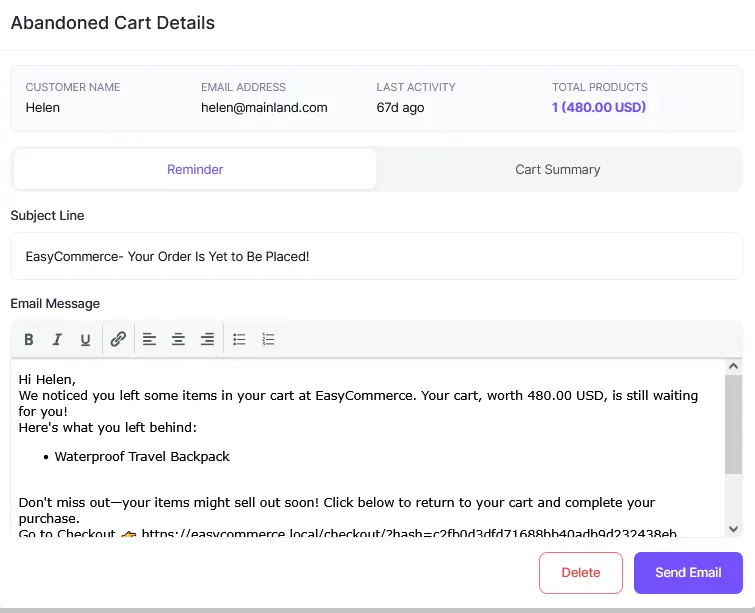
- Built-in abandoned cart tracking: When a shopper leaves checkout without finishing, their details are logged automatically in your dashboard. You set the delay that marks a cart as abandoned, so the timer matches how your customers shop. See the abandoned cart recovery feature for the full workflow.
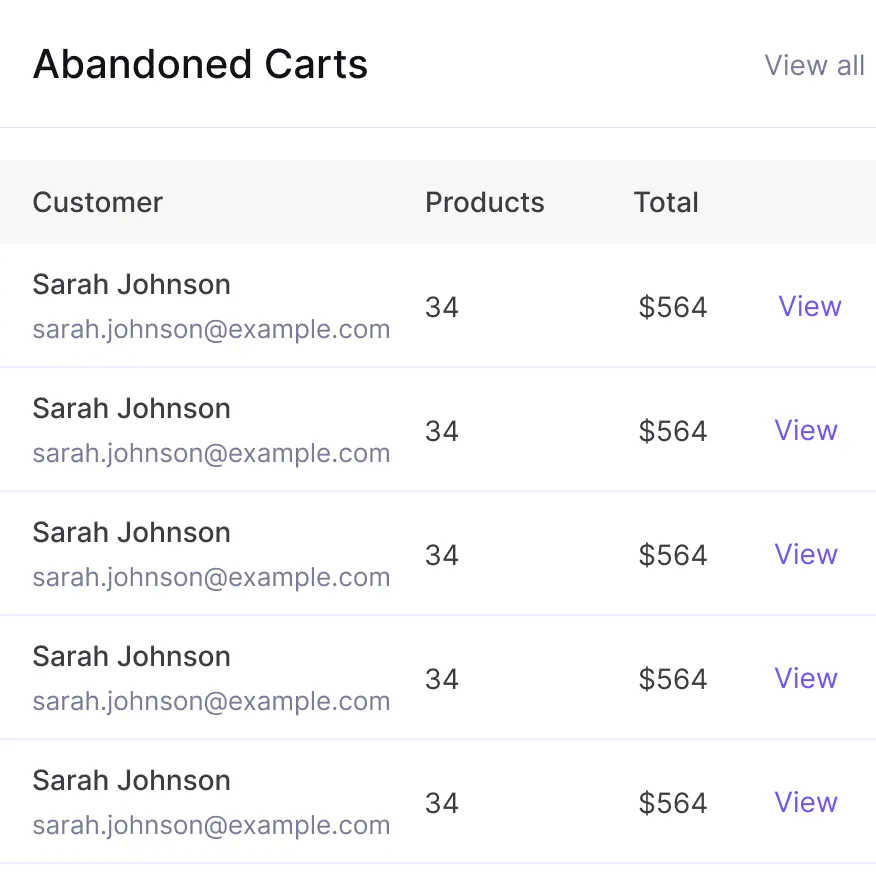
- Personalized recovery emails: You write a subject line and email body with placeholders that auto-fill the shopper’s name and the products they left. That ties directly into the timing principle above: send the first reminder fast, keep it personal. You can send these manually per cart or set them to go out automatically.
- A faster, cleaner checkout: Because the plugin is lightweight, checkout pages load quickly, which addresses the speed-related drop-off covered earlier. Support for multiple payment gateways also removes the preferred-payment-missing reason from the table above.
Worth being straight about the limits. EasyCommerce covers the core recovery loop, tracking, reminder timing, and personalized email, without a third-party tool. It does not run native SMS campaigns or retargeting ads, so for a full multi-channel setup, you will still pair it with an ads platform or SMS service.
For a lot of small and mid-size WordPress stores, though, the built-in email recovery handles the majority of recoverable carts on its own. It is free to start, with no transaction fees on the core plugin.
Let’s Summarize
Cart abandonment is not a leak you patch once. It is an ongoing part of selling online, and the stores that treat it that way recover the most. The good news: most of those lost carts are winnable.
Three takeaways to act on. First, set up a three-email sequence and send the first one within an hour, because timing drives most of the result. Second, fix the checkout friction that causes abandonment in the first place: surprise costs, forced accounts, and slow pages. Third, layer in a popup and retargeting once the email basics are running.
You do not need an enterprise stack to do this. If you run a WordPress store, you can start recovering carts today with the built-in tools in EasyCommerce and expand from there.
Frequently Asked Questions
Most stores recover 3 to 5% of abandoned carts with email alone. With a multi-channel setup (email sequence, exit popups, and retargeting), stronger programs reach 10 to 15%. The exact number depends on your traffic quality, product price, and how fast you follow up.
Send the first email within one hour of abandonment. Intent drops quickly after a shopper leaves, so a fast first reminder recovers the most sales. Follow up with a second email within 24 hours and a third after 48 to 72 hours, then stop.
Not in the first email. Lead with a plain reminder, and hold any discount for the final message in your sequence. Offering a coupon too early teaches shoppers to abandon carts on purpose to unlock a deal.
Yes. EasyCommerce includes abandoned cart recovery in the core plugin. Shoppers who leave checkout are tracked automatically, and you can set the timing and send personalized recovery emails from the dashboard, without a separate tool.