
A strong product can still struggle if its subscription price does not match the value customers receive. The model you choose affects who signs up, how predictable their bills are, and whether you can serve them profitably.
In 2026, customers expect clear pricing, flexible billing, and straightforward cancellation. A pricing mismatch can compound over renewals, so choosing a workable model early matters.
Quick answer: Subscription pricing models define how customers pay recurring fees. The five common models are flat-rate, per-seat, tiered, usage-based, and hybrid. Choose based on the value customers receive, how your costs scale, and whether buyers can predict their bill.
This guide compares the models, walks through pricing decisions and calculations, and explains what you can realistically implement in a WordPress store.
In this guide you will learn,
- What are subscription pricing models, and how do they work?
- How to choose the right subscription pricing model
- How to set your prices and tiers
- Monthly or annual billing
- How to keep subscribers
- Subscription pricing models on WordPress
- Frequently asked questions and conclusion
What Are Subscription Pricing Models?
Subscription pricing models determine what triggers a recurring charge: a fixed plan, number of users, feature package, volume of units, actual consumption, or a combination. Compare the five models below, then use the decision framework to narrow your choice.
| Model | Customer pays for | Best for | Main risk |
| Flat-rate | One fixed plan | Memberships, simple tools, courses | Heavy users underpay |
| Per-seat | Each user | Team software, client portals | Login sharing, seat shrinkage |
| Tiered | Quantity bands or features | SaaS and plugin businesses | Unclear boundaries or billing rules |
| Usage-based | Actual consumption | APIs, infrastructure, AI features | Unpredictable bills and revenue |
| Hybrid | Base fee plus metered add-on | Products with variable cost | Harder to explain and build |
5 Common Subscription Pricing Models
Subscription pricing models determine how much customers pay and what they get in return. Each model works differently depending on your product, target audience, and business goals. Let’s explore five common subscription pricing models and how they work.
1. Flat-Rate Pricing
Flat-rate pricing charges one fixed price for a defined plan. For example, a membership site may charge $29 per month for access to its community and resources. This approach is straightforward to explain, bill, and forecast.
The tradeoff is that low-usage customers may feel overcharged, while high-usage customers could cost more to serve than the price covers. If serving a heavy user costs significantly more, track margin by customer segment before keeping one price for everyone.
2. Per-Seat Pricing
Per-seat pricing charges for each person who needs access. It works when value grows with the number of people using the product, such as a team tool or a client portal.
The tradeoff is that customers may restrict seats or share accounts to limit their bills. Consider bundled seats or volume discounts when broad team adoption improves the experience.
3. Tiered Pricing: Quantity Tiers vs Feature Tiers
Tiered pricing can mean feature-based plans (such as Starter, Pro, and Agency) or quantity-based price bands. For quantity tiers, two billing methods are important: volume pricing applies the final tier rate to every unit, while graduated pricing charges each band at its own rate.
Here’s an example with three pricing tiers:
- 1–5 units: $7 per unit
- 6–10 units: $6.50 per unit
- 11+ units: $6 per unit
Now, let’s compare how the pricing works.
If a customer buys 6 units:
- Volume pricing: 6 × $6.50 = $39.00
- Graduated pricing: (5 × $7) + (1 × $6.50) = $41.50
If 25 units:
- Volume pricing: 25 × $6 = $150.00
- Graduated pricing: (5 × $7) + (5 × $6.50) + (15 × $6) = $157.50
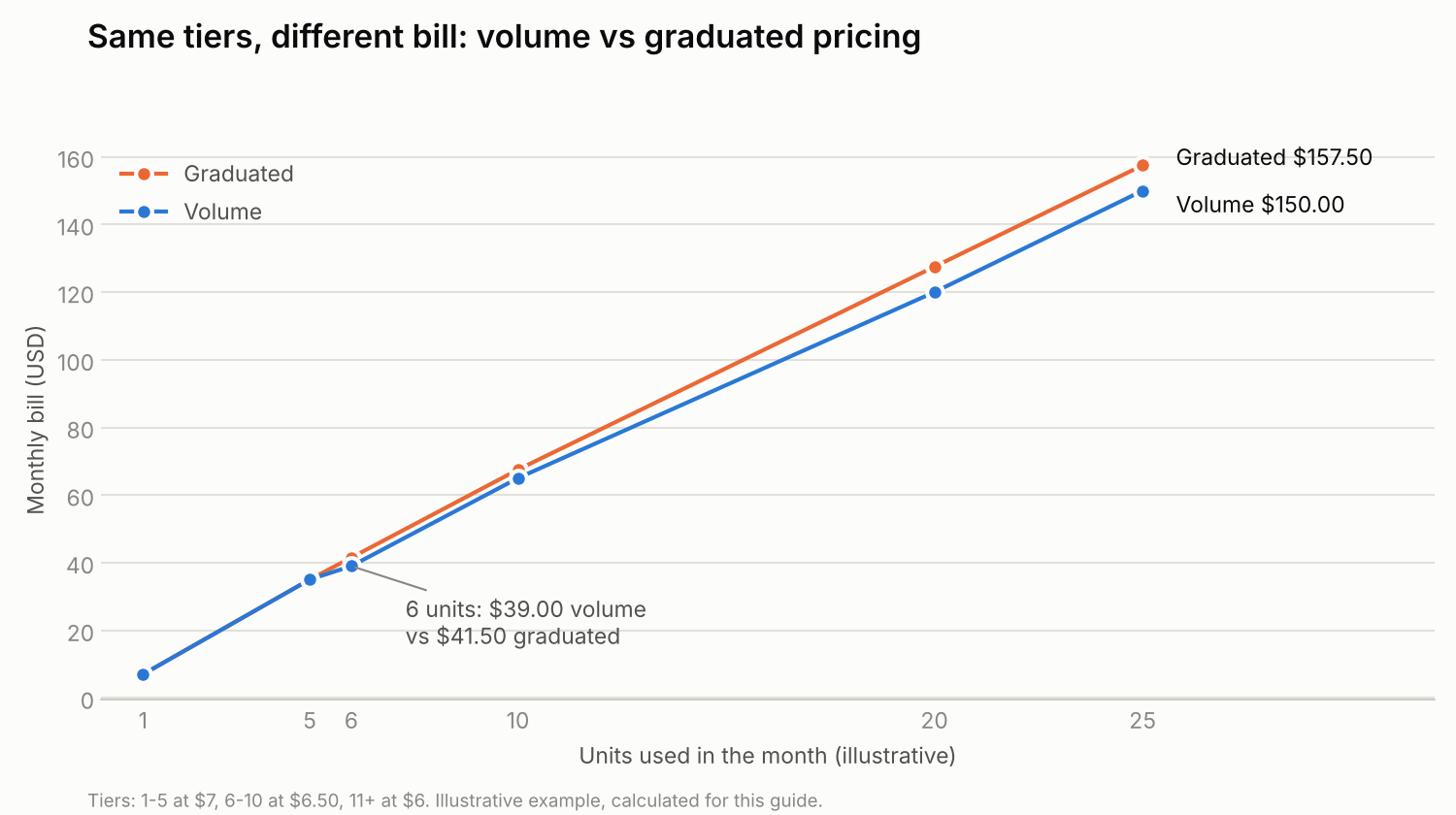
Graduated pricing avoids a sharp change in total price at a tier boundary, while volume pricing can create one. Whichever you use, show a worked invoice example so buyers can calculate their expected charge. Feature-based Starter, Pro, and Agency tiers are covered in the pricing section below.
4. Usage-Based Pricing
Usage-based pricing bills for what the customer consumes: API calls, storage, orders processed, emails sent. Customers are asking for it. Research by The Subscribed Institute with McKinsey & Company, drawing on Zuora’s subscription benchmark data, reports that customers increasingly want to move from flat fees to paying only for what they use.
For example, at $0.02 per 1,000 API calls, 500,000 calls cost $10 before any minimum fee.
Usage billing can reduce the “I’m paying for things I don’t use” objection. It also makes revenue harder to forecast and bills harder to predict, which is what finance teams and small buyers dislike. Metering needs real engineering, so make sure you can measure the thing before you charge for it.
5. Hybrid Pricing
Hybrid pricing combines a base subscription with a metered or per-seat component. A typical shape: $49 a month includes 1,000 units, then a low rate per extra unit. The customer gets a predictable floor, and you get upside from your heaviest users.
Some survey evidence points to interest in hybrid pricing. In Chargebee’s survey of 473 companies, 67% of hybrid-pricing companies expected better margins, against 32% of pure usage-based companies. That is one survey of software firms, so treat it as a direction, not a law. If your costs increase with consumption, test whether a metered component protects your margins without making bills confusing.
What About the Freemium Model?
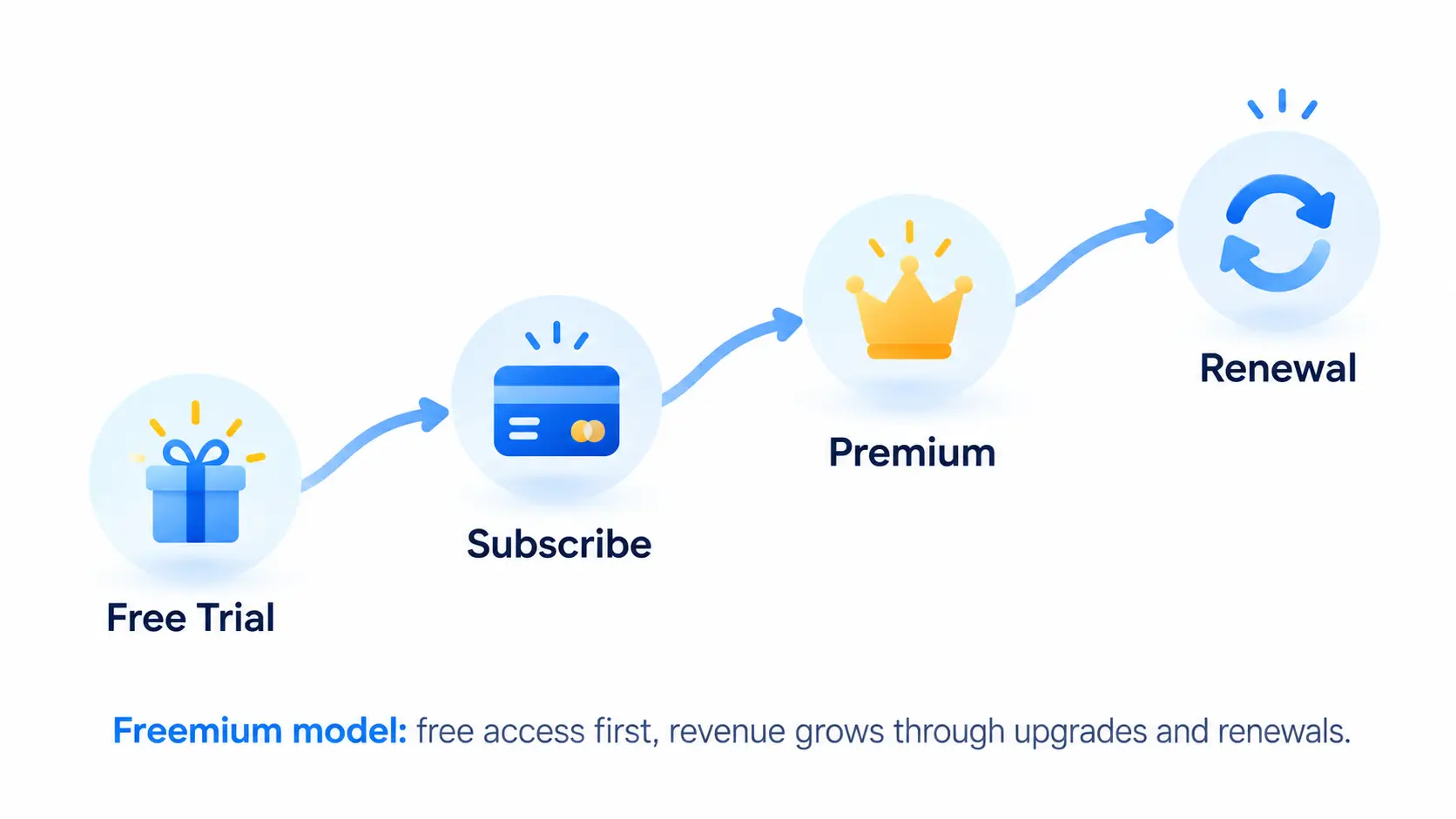
Freemium is less a pricing model than an acquisition tactic layered on top of one. A free plan brings users in, and a paid tier converts a share of them. It only works if the free plan is cheap to serve and the paid plan solves a problem the free one visibly cannot.
Now that you know the options, the next question is which one fits your business.
How to Choose the Right Subscription Pricing Model
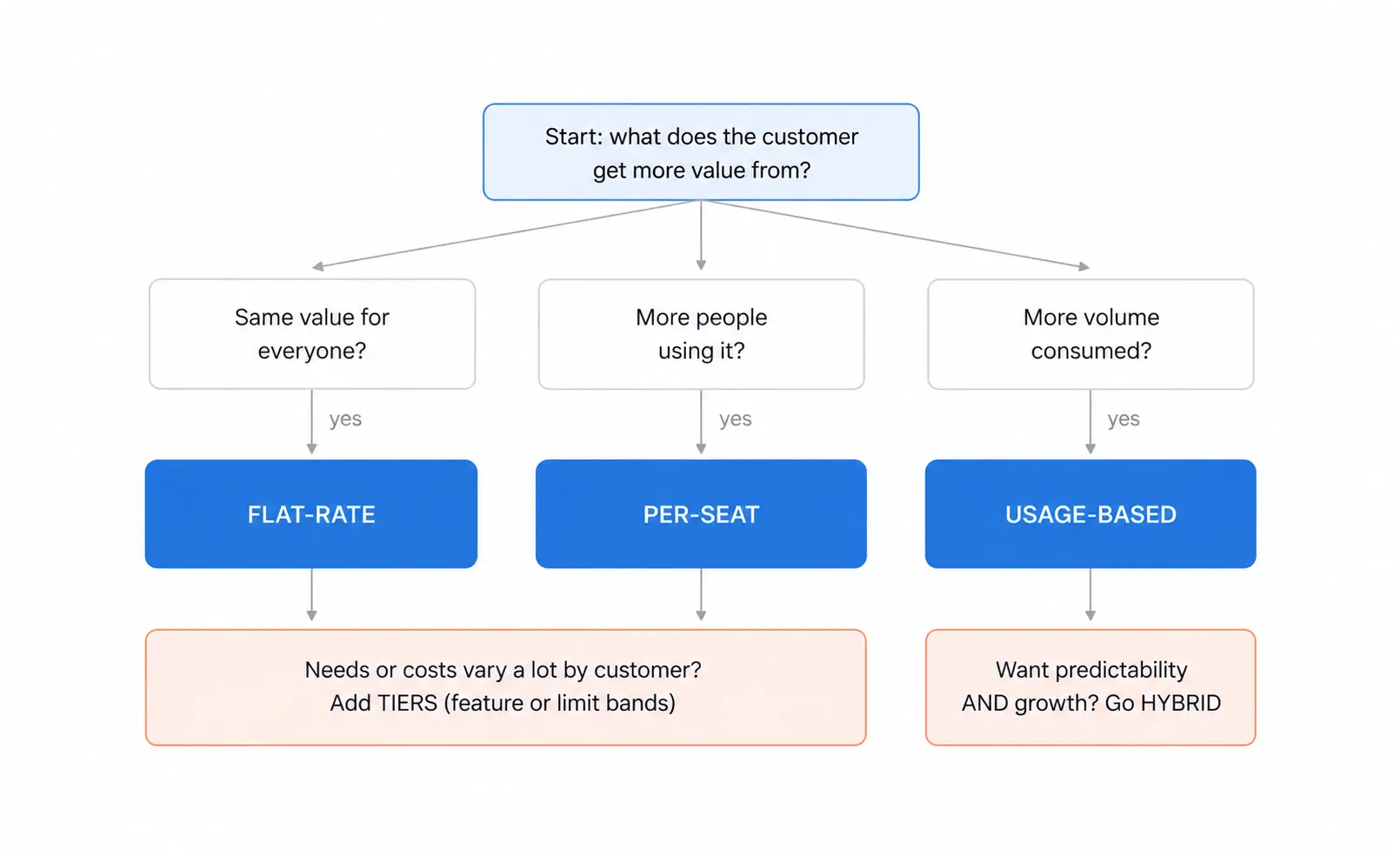
Choose the model whose billing metric your customer already treats as the measure of value. If more people using the product means more value, charge per seat. If more consumption means more value, meter it. If everyone gets the same outcome, keep it flat and add tiers only when customer needs genuinely differ.
Four Questions That Settle Most Decisions
Run your product through these in order.
- What does the customer get more value from? More users, more volume, or the same result regardless? That answer picks the base model.
- Does your cost to serve rise with usage? If yes, a pure flat rate will eventually hurt margin, so add a usage component.
- Can the customer predict their own bill? Small businesses and individuals usually want one fixed monthly number. Larger buyers tolerate variability when they can budget against a cap.
- Can you measure it cleanly? If you cannot meter a unit accurately and show it to the customer, do not bill for it.
Quick Picks by Business Type
If the four questions still leave you undecided, start from what you sell.
| You sell | Start with | Why |
| Memberships, communities, courses | Flat-rate, 2 to 3 tiers | Same value for everyone, predictable |
| Plugins, themes, software licenses | Tiered by sites or features | Value grows with number of sites |
| Client portals, team tools | Per-seat with a seat bundle | Value grows with users |
| Subscription boxes, replenishment | Flat-rate per box, with frequency options | Cost is per shipment, not per user |
| AI tools, APIs, anything metered | Hybrid: base fee plus usage | Cost and value both scale with use |
Per-seat and usage models are not limited to large companies. Still, for many WordPress businesses selling memberships, courses, or licenses, a simple flat-rate offer with two or three feature tiers can be easier to launch. Adopt metered billing when value and costs genuinely vary with consumption.
If you are planning to sell subscriptions through WordPress, choose the billing metric first, then confirm your store supports the renewal intervals, pricing variations, and payment methods you need.
Once you have a model, you need numbers.
How to Set Your Prices and Tiers
Set price from the customer’s perception of value, then check it against your costs. Pricing from cost alone sets a floor, not a price, and pricing from a competitor’s page copies their guesses. A short survey of your own audience beats both.
(i) Find the Acceptable Range First
The Van Westendorp price sensitivity meter is a simple research method. It asks four questions about price perception, and the answers form curves whose crossings mark an acceptable price range. SurveyMonkey’s guide to Van Westendorp describes the four resulting points:
marginal cheapness,
marginal expensiveness,
the optimal price point,
and the indifference price point.
You can start by asking customers or prospects the four questions. A few dozen responses can surface patterns, but a small or unrepresentative sample cannot establish a dependable market-wide price. Compare responses across customer segments and validate the range with actual purchase behavior.
(ii) Build Good, Better, Best Around Your Target Plan
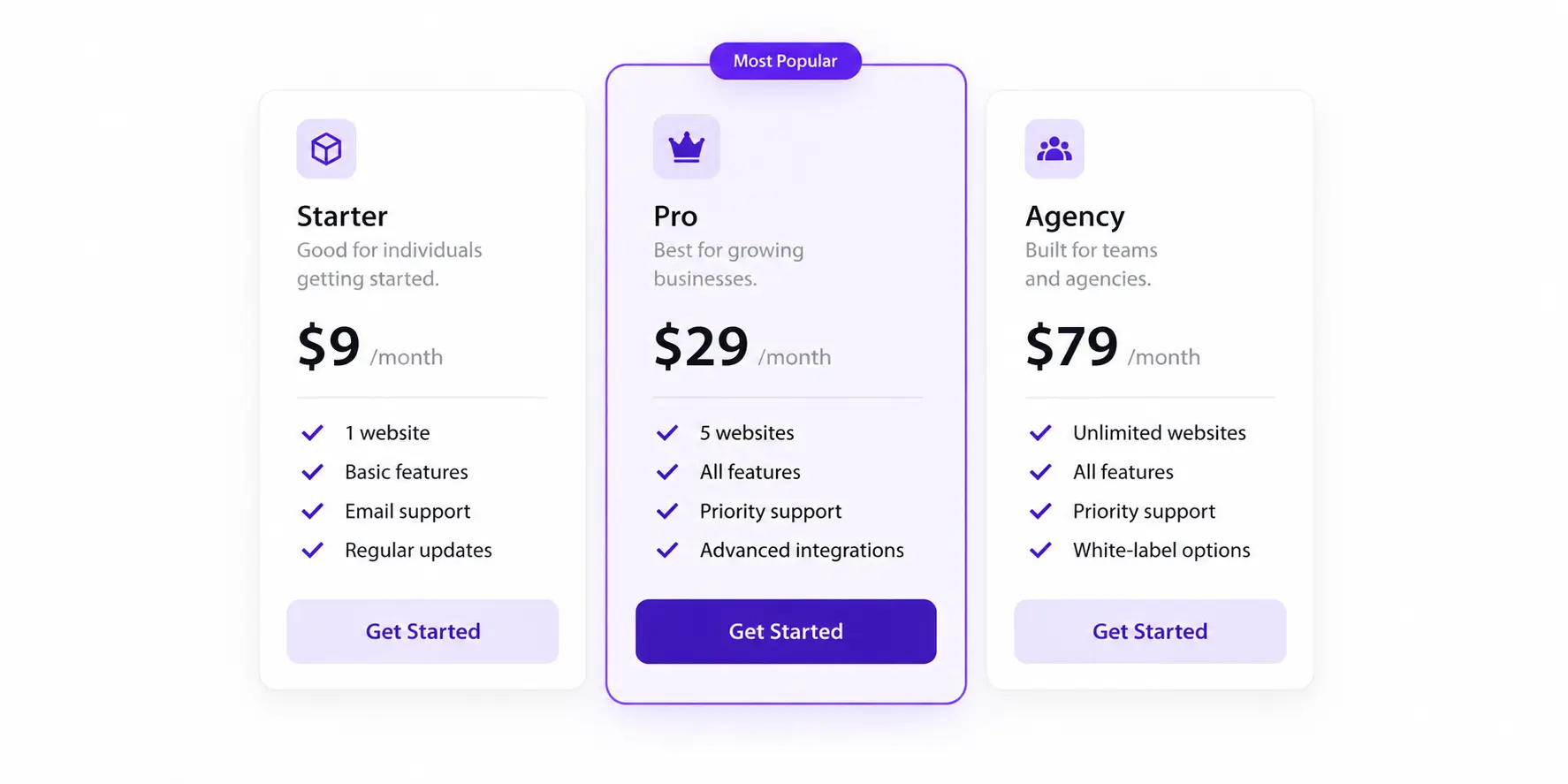
Three feature tiers are a useful starting point when customers have clearly different needs: an entry plan, a plan designed for your core customer, and a premium plan. Two tiers may be enough for a simpler product. Add more only when the differences are meaningful and easy to compare.
Start from the target tier, not the cheapest one. Decide what the customer you most want to keep needs actually, price that plan at a number you are happy to collect for years, then build the other two around it. Gate tiers on things that map to value (number of sites, products, seats, support level) rather than arbitrary feature scraps. The entry tier should solve a complete problem, with a clear upgrade path as needs grow.
(iii) Pricing Psychology: The Decoy Effect
How plans are compared can influence choices. A classic classroom demonstration illustrates the decoy effect. Dan Ariely described this in Predictably Irrational with an Economist subscription test. Offered web-only at $59 or print plus web at $125, 68 of 100 students took web-only and 32 took the bundle. After adding a print-only option at $125, which nobody chose, the split flipped to 16 and 84.
Run the numbers: the two-option version earns $8,012 per 100 students (68 x $59 plus 32 x $125). The three-option version earns $11,444 (16 x $59 plus 84 x $125). In this classroom example, the added option changes the selection mix and implies about 43% more revenue per 100 choices. It does not prove a typical business will achieve that lift. Wikipedia has a short explainer on the decoy effect as a cognitive bias.
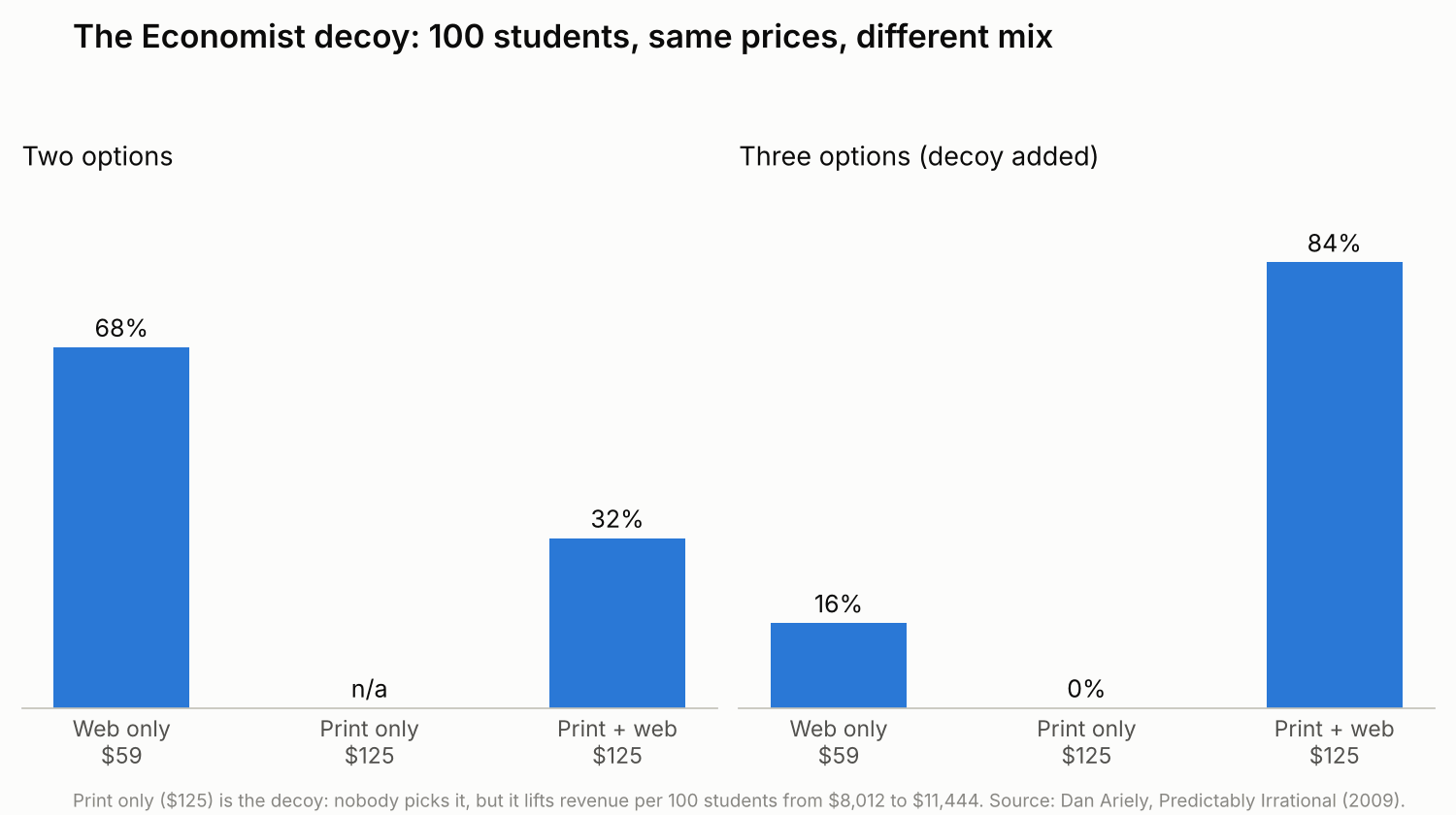
The lesson is to make plan differences clear, not to manufacture a misleading choice. Each plan should serve a real customer segment. Measure completed purchases and retention, not just which option attracts clicks.
With the prices set, the next lever is how often you bill.
Monthly or Annual Billing: What the Maths Says
If the economics work, offer both monthly and annual billing. Annual prepayment can improve cash flow and reduce the number of payment transactions, while monthly billing gives cautious customers a lower upfront commitment. Compare revenue and retention before assuming one is always better.
Churn Compounds Quietly
A monthly churn rate sounds small until you annualize it. Losing 3% of subscribers a month means losing about 30.6% in a year. At 5% a month, you lose 46% of the base (1 minus 0.95 to the power of 12).
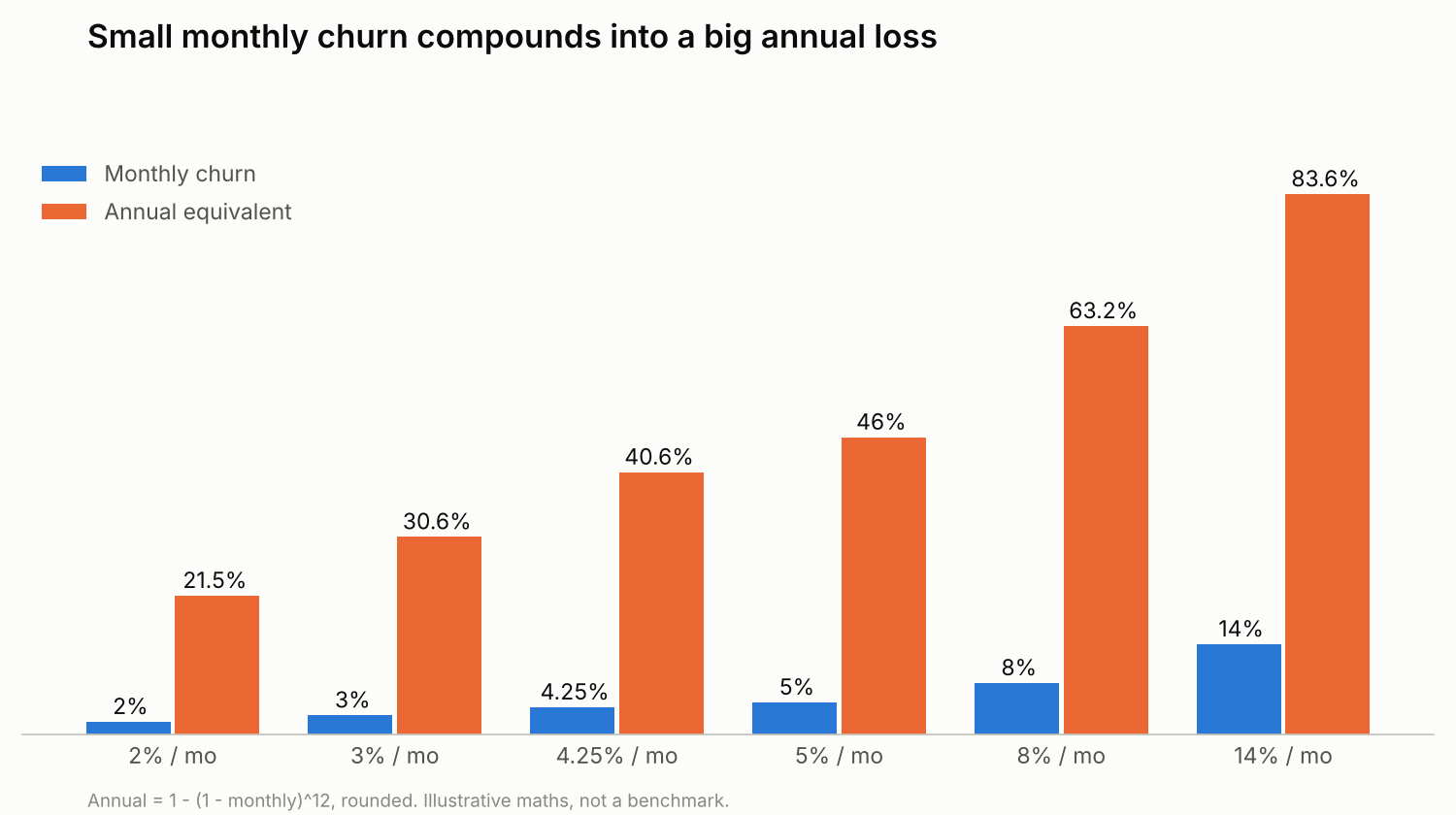
Annual billing typically reduces renewal frequency, but customers may still cancel or decide not to renew. Compare cohort retention and refund costs before assuming an annual discount pays for itself.
How Big Should the Annual Discount Be?
Two months free compared with twelve monthly payments equals about 16.7% off and is one practical test. Check whether upfront cash flow, retention, and fees offset the discount. Test “Save two months” against a percentage claim rather than assuming one message will always convert better.
Processing Fees Favor Annual Plans
Fixed fees hit small monthly charges hardest. Stripe’s standard US pricing is 2.9% plus 30 cents per successful domestic card transaction. On a $20 monthly payment, that is $0.88, or 4.4% of the charge. On a single $200 annual payment, it is $6.10, or 3.05%. Other gateways have their own fee schedules, so run the same calculation on yours.
Billing frequency set, the work shifts to keeping people subscribed.
How to Keep Subscribers: Churn, LTV and Failed Payments
Pricing and retention are one problem seen from two sides. A price you cannot defend with value will churn out customers, and a good price with broken renewals does the same thing more quietly. Fix the leak before you adjust the number.
The Simple LTV Formula
Customer lifetime value is average revenue per account, multiplied by gross margin, divided by churn rate. With $30 per month, 80% gross margin, and 5% monthly churn, LTV is $30 x 0.8 / 0.05 = $480. Cut churn to 3%, and the same customer is worth $800.
That is a 67% jump from a two-point churn improvement, with no price change at all. This simplified estimate assumes relatively stable revenue, gross margin, and churn. Use it as one input for acquisition spending, not as a complete financial forecast.
Voluntary vs Involuntary Churn
Voluntary churn is a customer deciding to leave. Involuntary churn is a payment failing while the customer still wants the product. According to Recurly’s churn benchmarks, ecommerce subscriptions show a median total churn of 4.25%, split into 2.87% voluntary and 1.38% involuntary. Recurly identifies these as median annual churn rates in its July 2026 industry research. Do not compare them directly with your monthly churn without aligning the measurement period and methodology.
Notice the share: roughly a third of churn in that data is payments that failed, not customers who chose to go. Payment recovery is often a productive area to investigate because it addresses customers who may still want the service.
Recover Failed Payments Automatically
Failed renewals are usually recoverable: expired cards, temporary declines, insufficient funds. Use payment retries that space attempts over days, not hours, such as Stripe’s Smart Retries (with retry timing configured for your business and applicable payment rules), and pair them with pre-renewal reminder emails and a clear “update your card” link.
Some declines cannot be retried, such as lost or stolen cards. Those need a new payment method before another charge can run.
Make Cancelling Easy, and Stay Compliant
Make cancellation as easy as sign-up. The FTC’s Click-to-Cancel rule was vacated by the Eighth Circuit in July 2025, and the FTC restarted the process in 2026, but the rules have not gone away. According to Goodwin’s legal summary, enforcement continues under the Restore Online Shoppers’ Confidence Act (ROSCA). The FTC’s ROSCA page says sellers must clearly disclose material terms and obtain express informed consent. ROSCA also requires a simple mechanism to stop recurring charges, and state auto-renewal laws can be stricter.
This is general information, not legal advice. Check the rules in each market you sell to, including EU requirements.
You now have the full picture. Here is what it looks like in practice on WordPress.
Subscription Pricing Models on WordPress: What Is Realistic
On WordPress, flat-rate subscriptions and feature-based tiers are practical starting points. Before promising free trials, metered usage, seat-based billing, or pausing, confirm what your selected subscription tool can actually do.
What EasyCommerce Subscriptions Supports
EasyCommerce’s Subscriptions add-on supports billing intervals by day, week, month, or year, fixed-term plans that stop after a set number of payments, monthly and yearly prices as product variations, renewal discounts, renewal reminders and failed-payment emails, and customer cancellation from the account area. Stripe handles automatic recurring charges. The add-on needs a Pro license, while the core plugin is free. The subscriptions feature page has the full list.
The current product documentation does not establish built-in metered usage, free trials, setup fees, customer-initiated plan changes, or pausing. Confirm those requirements with the latest release or your own test store before advertising them. For straightforward recurring products, fixed pricing and feature-based variations are an easier starting point than custom metering. For setup steps, follow our guide on how to sell subscriptions with WordPress.
[Screenshot: the EasyCommerce product editor showing a subscription product with billing interval, “Stop After (Cycles)” field and monthly and yearly variations]
Check Your Model Against Your Tools
If your plan needs per-seat licensing or metered usage, confirm your plugin supports it before you commit. Tools differ here, so compare against the current WooCommerce Subscriptions feature list instead of assuming. If you sell software, our guide to selling software licenses online shows how recurring billing pairs with license keys, and the digital products guide covers the catalog side.
Your Launch Checklist
- Pick the value metric your customer already understands.
- Choose flat-rate or tiered unless your costs clearly scale with usage.
- Start with two or three clearly differentiated tiers if customers need options.
- Test annual pricing against cash flow, margins, and actual retention.
- Turn on renewal reminders and failed-payment emails.
- Make cancellation simple and the terms clear before checkout.
- Review churn after 90 days, then adjust prices with data.
Final Words
Good subscription pricing models share three traits: the price follows a metric customers already see as value, the tier ladder is built around the plan you want most people to choose, and the billing system quietly protects the revenue it earns.
Match the model to what customers value, offer only tiers you can explain, and make renewal and cancellation policies clear. After launch, review conversion, margin, payment failures, and churn by cohort before changing prices.
Frequently Asked Questions
Flat-rate pricing with two or three tiers is a good starting point. It is simple to manage and provides predictable revenue. Consider hybrid pricing if costs increase with usage.
Two or three tiers work well for most businesses. Each tier should offer clear value and meet different customer needs.
Yes, if it suits your business. Annual billing can improve cash flow, while monthly billing offers flexibility. Consider offering both with a discount on annual plans.
Volume pricing applies one rate to all units based on the total quantity. Graduated pricing charges different rates for each tier. For example, six units might cost $39 with volume pricing versus $41.50 with graduated pricing.