
Every season punishes ecommerce stores in one of two ways. Either the bestseller sells out three days into the rush, and you watch ready-to-buy customers click away, or the season ends with shelves full of stock that ties up cash you needed for the next push.
Both are forecasting problems, and both are avoidable. Seasonal inventory planning for ecommerce is the discipline of matching what you stock to demand you can actually see coming, holidays, weather swings, cultural events, and the growing calendar of sale days.
The frustrating part? This demand is largely predictable, yet plenty of stores still treat every peak like a surprise. This guide lays out a repeatable framework, from the moment you should start planning to the cleanup after the rush, so each season gets a little less chaotic than the last.
TL;DR
- Start planning one full supplier lead-time cycle before demand rises, usually 2-4 months out, and 6-12 months for big peaks like the holidays.
- Forecast from your own sales history first, then layer in promotions, weather, and trends. AI tools can cut forecast error meaningfully, but only if your underlying data is clean.
- Set a reorder point (demand during lead time + safety stock), so you reorder before you run dry, and size safety stock according to how unpredictable the season is.
- Lock in suppliers early, track stock in real time, and get seasonal pages live ahead of the rush.
- Have an exit plan for leftovers, then run a post-season review so next year’s forecast is sharper.
The Seasonal Inventory Planning Process at a Glance
If you do nothing else, run this six-step loop for every demand window:
- Map your season calendar: list every demand spike your catalog touches, not just the holidays.
- Forecast demand: start from last year’s sales for the same window, then adjust for promotions and trends.
- Set reorder points and safety stock: decide when to reorder and how big a buffer the season needs.
- Order early and lock in suppliers: place orders a full lead-time cycle before demand climbs.
- Track stock in real time: watch fast-movers against their reorder points and react before they sell out.
- Clear leftovers and review: move dead stock smartly, then study the numbers to sharpen next season.
The rest of this guide breaks each step down.
What Is Seasonal Inventory Planning?
Seasonal inventory planning is the practice of adjusting your stock levels, ordering timelines, and cash allocation to match demand that spikes and dips at predictable times of year. Think winter coats, Valentine’s gifts, back-to-school supplies, or anything that surges around a marketplace sale event.
It’s a different mindset from how most stores run the rest of the year, and the difference matters more than it sounds.
Seasonal Stock vs. Regular Stock
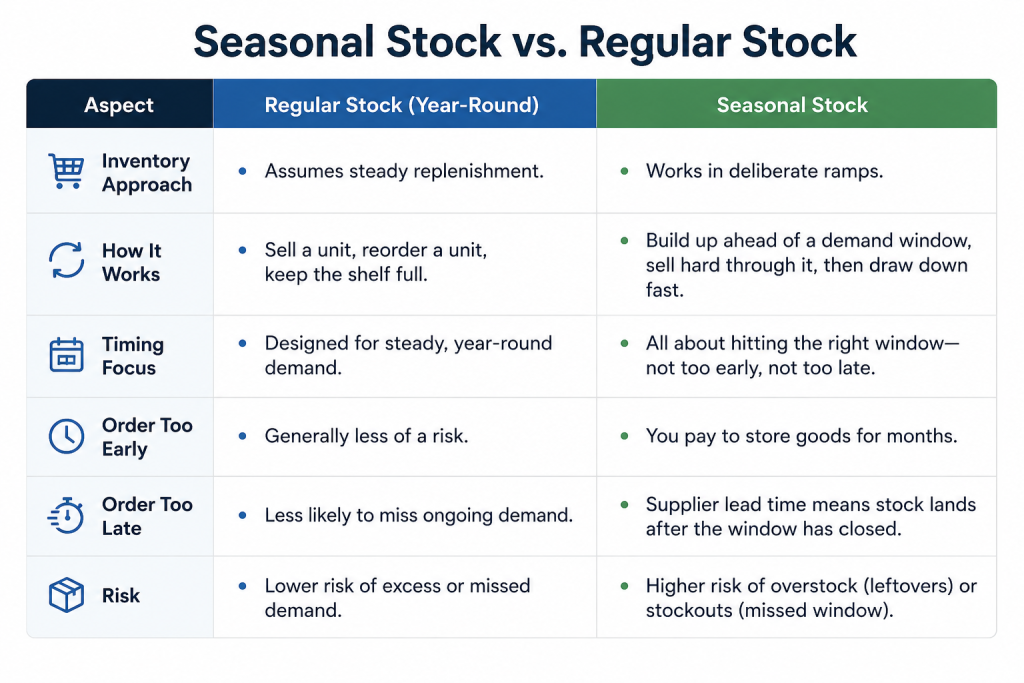
Regular, year-round inventory assumes steady replenishment, sell a unit, reorder a unit, keep the shelf full. Seasonal stock works in deliberate ramps. You build up ahead of a demand window, sell hard through it, then draw down fast so you aren’t left holding product nobody wants in February.
That timing is the whole game. Order too early and you pay to store goods for months. Order too late and your supplier’s lead time means the stock lands after the window has closed.
What Stockouts and Overstock Actually Cost You
The margin for error here is thin, and the numbers are sobering. Carrying excess inventory typically costs ecommerce businesses 20-30% of the inventory’s value every year once you add up storage, insurance, and depreciation. On the other side, running out during peak season can cost a brand a similar share of the revenue it could have captured.
Stockouts hurt year-round, too. The average retailer loses roughly 10% of annual revenue due to being out of stock. Multiply that across a peak season, when traffic is highest, and competitors are one search away, and a single miscalculation can wipe out a quarter’s profit.
When Should You Start Planning?
Start planning one full supplier lead-time cycle before demand begins to climb. For most ecommerce brands, that works out to two to four months ahead once you account for production, shipping, and fulfillment delays.
For the heavy hitters, Q4, the holiday shopping season, give yourself far more runway. The general guidance is to begin forecasting 6-12 months out for major peaks, with a shorter 3-6 month horizon fine for smaller or weather-driven events. If your products come from overseas suppliers with long, variable lead times, lean toward the earlier end.
Here’s a rough starting-point guide by event type:
| Demand window | When to start planning |
| Major holiday peak (Q4, Black Friday) | 6-12 months ahead |
| Mid-size seasonal or gifting event | 3-6 months ahead |
| Weather-driven or short-window product | 2-4 months ahead |
| Overseas-sourced stock (any season) | Add 1-2 months to the above |
Treat these as floors, not targets. The longer and less reliable your supplier lead time, the earlier you start.
Build a Simple Season Calendar
Most store owners think “seasonal” and immediately picture December. That’s a trap. Your real calendar is wider than the holidays.
Map every demand window your catalog actually touches: weather-driven swings (sunscreen in summer, heaters in winter), cultural and gifting moments, back-to-school, and the marketplace mega-sales that now stack up across the year. If you sell perishable or short-shelf-life goods, say, you run an online grocery store with seasonal stock, your windows are tighter, and your timing has to be more precise. Put each one on a single calendar with its lead time noted, and your ordering decisions stop being guesses.
How to Forecast Seasonal Demand
Forecasting is where seasonal planning either works or quietly falls apart. The goal isn’t a perfect prediction, it’s a defensible estimate you can act on and refine.
Start With Your Own Sales Data
Your best forecasting tool is the data you already own. Pull last year’s sales for the same window, broken down by product, and look at how demand built and faded. Three or more years of history is even better, because it smooths out one-off flukes.
Watch for patterns the raw totals hide: which SKUs spiked, which ramped slowly, which sold out and might have sold more if you’d had stock. That last group is easy to miss and expensive to ignore.
Add Outside Signals
History tells you what happened, not what’s about to change. Layer in the context your spreadsheet can’t see: planned promotions, pricing changes, new product launches, broader category trends, even weather forecasts for weather-sensitive goods.
This is also where solid ecommerce market research pays off. Knowing where your category is heading helps you separate a genuine demand shift from random noise, and stops you from over-ordering on a trend that’s already cooling.
Where AI Forecasting Fits in 2026
Can AI actually make your forecasts better? The evidence says yes, with a caveat. McKinsey’s research points to AI and machine-learning methods delivering a 10-20% improvement in forecast accuracy, which tends to translate into roughly 5% lower inventory and a 2-3% revenue bump. Other analyses report AI cutting forecast error by as much as 50% versus traditional methods.
The accuracy gap shows up in the metrics, too. AI-driven SKU-level forecasting often lands a MAPE under 25%, compared with the 35-50% error range common in manual approaches.
AI also handles something humans rarely do well at scale: dynamic reorder points that rise heading into a season and fall as it winds down.
Here’s the caveat, and it’s a big one. AI doesn’t fix dirty data, it amplifies it. If your sales records are messy or your channels don’t sync, a model will just produce confident, wrong answers faster.
Fix the inputs before you reach for the algorithm. For most small and mid-size stores, that means getting clean, consolidated sales data in place first, then deciding whether a forecasting tool earns its keep.
How to Set Safety Stock and Reorder Points
Once you have a demand estimate, two numbers turn it into action: your reorder point and your safety stock. Get these right, and you reorder at the correct moment, with enough buffer to survive a surprise.
The Reorder Point Formula
A reorder point is simply the stock level that triggers your next order. The widely used formula is:
Reorder point = (average daily demand × lead time in days) + safety stockSo if you sell 27 units a day, your supplier takes 17 days to deliver, and you hold 241 units of safety stock, your reorder point lands around 700 units. When inventory hits 700, you place the order, and the new stock arrives before you’d otherwise run out.
| Input | Example value |
| Average daily demand | 27 units |
| Supplier lead time | 17 days |
| Safety stock | 241 units |
| Reorder point | (27 × 17) + 241 = 700 units |
The trap most stores fall into is setting a reorder point once and forgetting it. During a season, your daily demand isn’t flat, so a static number goes stale fast. Recalculate as the season ramps.
How Much Safety Stock to Hold
Safety stock is your cushion against two things going wrong at once: demand running hotter than expected, and supply arriving later than promised. The more volatile the season, the bigger the cushion you need.
A simple way to size it:
Safety stock = (max daily sales × max lead time) − (average daily sales × average lead time)For high-variability seasons, the statistical version gives a tighter result:
Safety stock = Z × σ × √(lead time)Here, Z is a service-level factor (a higher Z means you’re willing to hold more stock to avoid stockouts), σ is the variability in your demand, and the square-root term accounts for lead time. You don’t need to love the math, the point is that unpredictable demand and unreliable suppliers both push your safety stock up. Build the buffer around your real variability, not a comfortable average.
How to Execute Your Seasonal Plan
A forecast on paper means nothing until it’s stocked on a shelf and a checkout that converts. Execution is where good plans go to die, usually because suppliers, systems, or store setup weren’t ready in time.
Lock In Suppliers Early
Your forecast depends on the stock actually showing up. Get ahead of it by pre-booking orders and securing priority access with your suppliers before the season’s crunch hits everyone at once. It also helps to have a backup supplier for your core SKUs, relying on a single source is fine until the one season you can’t afford a delay is the season it happens.
Track Stock in Real Time
You can’t manage what you can’t see. Real-time inventory tracking is what keeps your reorder points honest and flags trouble before it becomes a stockout.
This is where your store platform earns its place. EasyCommerce includes built-in inventory tracking with low-stock alerts, so you get a heads-up the moment a fast-mover dips toward your reorder point, no manual spreadsheet check required. For stores moving real volume during a peak, that early warning is often the difference between a quick reorder and an empty product page. If you’re still weighing your foundation, it’s worth choosing the right ecommerce platform before a big season rather than during it.
Get Seasonal Pages and Promos Live Fast
Seasonal selling lives and dies on speed. You need product pages, bundles, and promo copy ready before traffic arrives, not scrambled together the night before.
This is one area where AI genuinely saves hours. EasyCommerce’s built-in AI content tools can draft product descriptions and seasonal promo copy from a few details, so spinning up a holiday landing page or a limited-time bundle takes minutes instead of an afternoon. The plan still has to come from you, but the busywork doesn’t.
What to Do After the Season Ends

The season ending isn’t the finish line. What you do with leftover stock, and what you learn from the numbers shapes how well next year goes.
Clear Leftover Stock Without Killing Margin
Unsold seasonal inventory quietly drains you, it eats storage space and locks up cash you need elsewhere. Move it, but move it smartly.
Bundle slow-movers with your bestsellers, run targeted clearance promotions, or open up an alternate channel like a marketplace or flash-sale site. The instinct to slash prices to zero is understandable, but heavy across-the-board discounting trains customers to wait for markdowns. Be deliberate about which items get cut and how deep.
Review What Happened
This is the step almost everyone skips, and it’s the one that compounds. Sit down with the season’s data while it’s fresh: Where did you stock out? What sold through cleanly? What’s still sitting in the warehouse?
A modest forecasting improvement pays off more than you’d think, one analysis found a 15% gain in forecast accuracy can lift pre-tax profit by around 3%. Every honest post-season review feeds the next forecast, which is how seasonal inventory planning gets easier and more accurate over time instead of staying a yearly fire drill.
Final Words: Bringing It All Together
Seasonal demand will always swing, but it doesn’t have to catch you off guard. The stores that handle it well do three things consistently: they start planning a full lead-time cycle before demand rises, they forecast from real sales data instead of gut feel, and they have a clear exit plan for whatever doesn’t sell. None of that requires fancy tools, just a calendar, your own numbers, and the discipline to act on them early.
Your first season planned this way will still have rough edges, and that’s fine. The payoff compounds: every honest post-season review makes the next forecast sharper, until the peaks you used to dread become the stretch of the year you’re most ready for.
Frequently Asked Questions
Start 6-12 months ahead for the holiday peak. Q4 is the single biggest demand window for most ecommerce stores, and suppliers get backed up as everyone orders at once. If you source from overseas or have long lead times, begin at the early end of that range. For smaller seasonal events, 3-6 months is usually enough runway.
Hold enough to cover the gap between your worst-case demand and your worst-case lead time. The simple formula is (max daily sales × max lead time) - (average daily sales × average lead time). The more volatile the season and the less reliable your suppliers, the larger that buffer should be. Resist setting it once, recalculate as demand ramps, because a number that worked in the off-season will be too low at peak.
Yes, with a condition. AI and machine-learning models have been shown to improve forecast accuracy by 10-20% and reduce error rates substantially compared with manual methods, partly because they adjust reorder points dynamically across a season. But AI only works on clean, connected data. If your sales records are messy or your channels don't sync, fix that first, otherwise a model just makes confident mistakes faster.
Clear it without gutting your margin. Bundle slow-movers with popular items, run targeted promotions rather than blanket discounts, or sell through an alternate channel like a marketplace or flash-sale site. Whatever's truly unsellable can be donated or recycled to free up storage and stop it from draining holding costs. The goal is to recover cash and space, not to dump everything at any price.
Heavily. Every unit you pre-buy for a season is cash locked in a box until it sells, and carrying costs keep ticking, often a fifth to a third of the stock's value over a year. Over-ordering can quietly starve the marketing, payroll, or restocking you need to actually capture the peak. The fix is to tie order quantities to a defensible forecast rather than optimism, and to stagger reorders where lead times allow so you aren't committing all your capital months before the season pays you back.