A 30% discount for Black Friday looks good on a banner. But does it leave you with enough profit?
Say you sell a product for $100. It costs you $60 to buy, package, and deliver. Normally, you have $40 left from each sale before paying your other business expenses.
Now offer 30% off.
The customer pays $70, and you’re left with just $10. You’ve given away three-quarters of the money that was available to cover your other costs and profit.
And if you spend another $12 on advertising to get that order, you’re already losing money.
That’s the problem with choosing a discount based on what other stores are offering.
So, how much should you discount for Black Friday?
We’ll work through the numbers, compare a few ways to structure your sale, and use a calculator to find a discount your store can actually afford.
How Much Should You Discount for Black Friday?
The right Black Friday discount depends on your product costs, selling expenses, and the margin you want to keep. Calculate your lowest acceptable selling price first. Then choose a discount that customers will find attractive without leaving your business short of money.
There’s no single percentage that works for every store.
If a product sells for $100 and costs $65 to fulfill, you have $35 to work with. That doesn’t mean you should offer 35% off. It means anything above that would lose money on the sale, even before fixed business expenses.
Now compare that with a $100 product that costs just $25 to deliver. There’s much more room to work with.
Both products have the same selling price, but they shouldn’t necessarily have the same discount.
Should you offer 10%, 20%, or 30% off?
According to Adobe’s 2026 holiday shopping forecast, US online discounts are expected to reach as high as 30% during Cyber Week. Electronics, toys, and several other categories are expected to see substantial discounts.
But that’s a forecast of market activity, not a recommendation for your store.
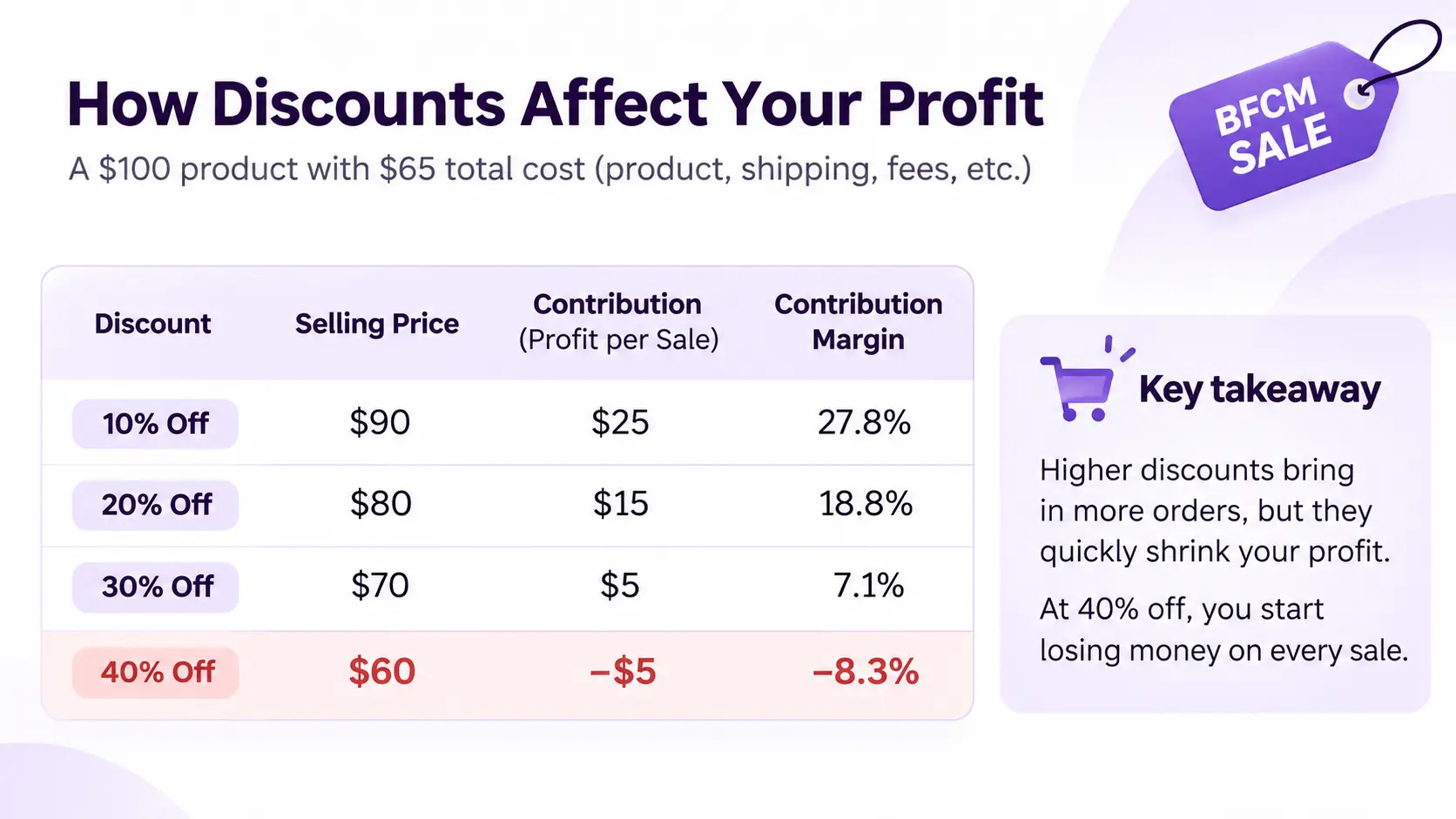
Let’s use a product that costs $65 per sale.
| Discount | Customer pays | Money left after variable costs |
| No discount | $100 | $35 |
| 10% off | $90 | $25 |
| 20% off | $80 | $15 |
| 30% off | $70 | $5 |
| 40% off | $60 | -$5 |
At 10% off, there’s still $25 left. At 20%, that drops to $15.
A 30% discount leaves just $5, and 40% puts the order in the red.
Going from 20% to 30% off may not look like much to a shopper, but it cuts the profit per order from $15 to $5.
You’d need three sales at 30% off to generate the same contribution as one sale at 20% off.
That’s why I wouldn’t start by picking a percentage. I’d calculate what the store can afford, then decide whether that discount is attractive enough for customers.
How to Calculate Your Maximum Profitable Black Friday Discount
To calculate your maximum sustainable discount, subtract your selling costs from the original price, decide how much contribution margin you need to keep, and work backward to your minimum selling price.
You only need a few numbers to get started.
Let’s use a $100 backpack as an example.
1. Find out what one sale actually costs
Here’s what you spend when someone orders it:
| Expense | Cost |
| Backpack | $45 |
| Packaging | $5 |
| Shipping paid by your store | $10 |
| Payment and other selling fees | $5 |
| Total variable cost | $65 |
So far, that leaves $35.
But your expenses don’t necessarily stop here.
If you use paid ads, offer free returns, or pay marketplace commissions, those costs also affect what you keep.
And your monthly expenses, such as hosting, software, salaries, and rent, still need to be paid.
For now, we’ll use the $65 variable cost to understand the effect of discounting.
This follows the same basic principle explained in Stripe’s guide to cost-based pricing: understand your costs first, then check whether the price works for your business and your customers.
2. Calculate your contribution margin
The calculation is simple:
Contribution per sale = Selling price – Variable costs
For the backpack:
$100 – $65 = $35
That $35 is your contribution per sale. It’s the money available to cover fixed business expenses and, hopefully, leave a profit.
To calculate the contribution margin:
Contribution margin (%) = (Contribution per sale ÷ Selling price) × 100
($35 ÷ $100) × 100 = 35%
Your contribution margin is 35%.
Why does the percentage matter?
Because you’ll probably sell products at different prices. Looking at their margins makes it easier to compare how much room you have for discounts.
Just don’t confuse contribution margin with net profit margin. They’re not the same thing.
3. Find your break-even discount
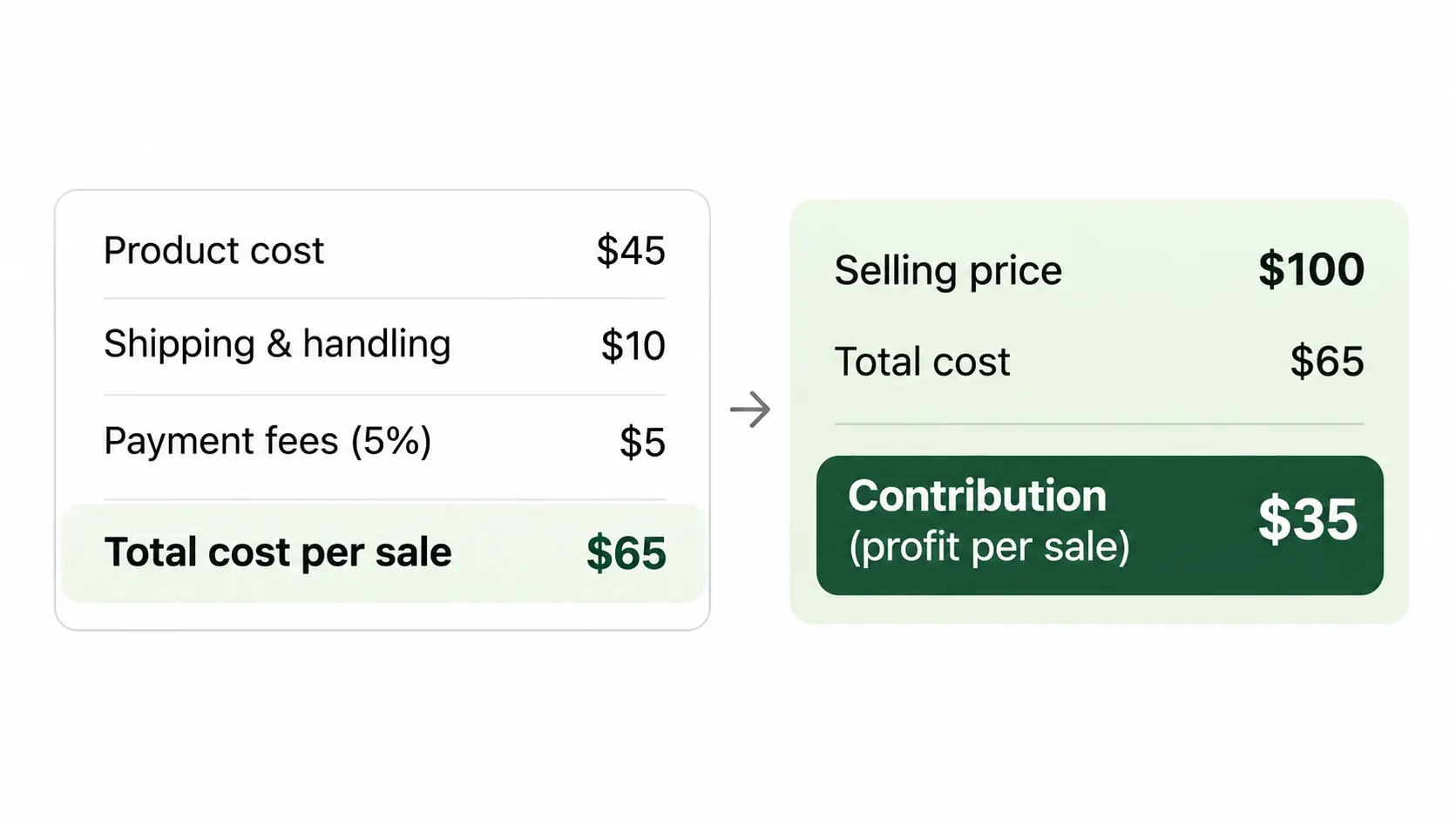
Your backpack sells for $100 and costs $65 per order.
How far can you reduce the price before there’s nothing left?
Break-even discount (%) = [(Original price – Variable costs) ÷ Original price] × 100
($100 – $65) ÷ $100 × 100 = 35%
So 35% is the break-even discount based on the costs we’ve included.
At 35% off, the customer pays $65. You receive enough to cover those variable costs, but nothing remains for other business expenses.
That’s not much of a business plan.
You need some money left after each order.
Note: This simplified formula assumes the entered variable costs remain constant. If payment fees change with the transaction value, recalculate those fees using the discounted price.
4. Decide how much margin you want to keep
Suppose you want a minimum contribution margin of 10% on the discounted price.
Your selling price needs to cover the $65 cost while leaving 10% of the final price available.
Here’s the formula:
Minimum selling price = Variable costs ÷ (1 – Target margin)
$65 ÷ 0.90 = $72.22
So the lowest price you should offer, under this target, is approximately $72.22.
Now calculate the discount:
Maximum sustainable discount (%) = [(Original price – Minimum selling price) ÷ Original price] × 100
($100 – $72.22) ÷ $100 × 100 = 27.78%
You could choose 25% off and leave a little more room.
Is 10% the right target for your business? Not necessarily. It depends on your operating costs, advertising budget, and how much profit you need.
The point is to choose your target before making the offer, not after the orders start coming in.
Black Friday discount formulas at a glance
| What you want to calculate | Formula |
| Discounted price | Original price × (1 – Discount rate) |
| Contribution per sale | Discounted price – Variable costs |
| Contribution margin | Contribution ÷ Discounted price × 100 |
| Break-even discount | (Original price – Variable costs) ÷ Original price × 100 |
| Minimum price for a target margin | Variable costs ÷ (1 – Target margin) |
| Maximum discount for a target margin | (Original price – Minimum price) ÷ Original price × 100 |
Use percentage rates as decimals when calculating. For example, 20% is 0.20.
These formulas provide a starting point for pricing decisions. They don’t replace an assessment of fixed expenses, expected returns, advertising costs, or changes in transaction-based fees.
Black Friday Profit & Discount Calculator
Doing this for every product can get repetitive, especially when you’re considering different offers.
Use the calculator below to see what happens to your margins when you change the discount.
Black Friday Profit Calculator
See how much discount you can afford before launching your Black Friday sale.
Packaging, shipping, advertising and other fixed costs per order. Don’t include percentage-based fees here.
Payment or platform fees charged as a percentage of the selling price.
The percentage of the discounted price you want left after variable costs.
These calculations estimate contribution after the costs you enter, not final net profit. Fixed business overhead, taxes, refunds and unentered expenses are excluded. The model assumes constant per-order costs and fees calculated on the discounted selling price.
Enter your regular price, product costs, additional selling expenses, planned discount, and target contribution margin.
The calculator will show:
- The price customers will pay
- How much money remains per sale
- Your contribution margin after discounting
- The discount that would bring your contribution to zero
- The maximum discount that meets your target margin
Try it with a few different percentages.
You might find that 20% off gives you enough room to run ads, while 30% off leaves almost nothing.
Or perhaps one product can handle 40% off without a problem.
That’s useful to know before choosing which products will carry your Black Friday promotion.
How many more orders do you need after offering a discount?
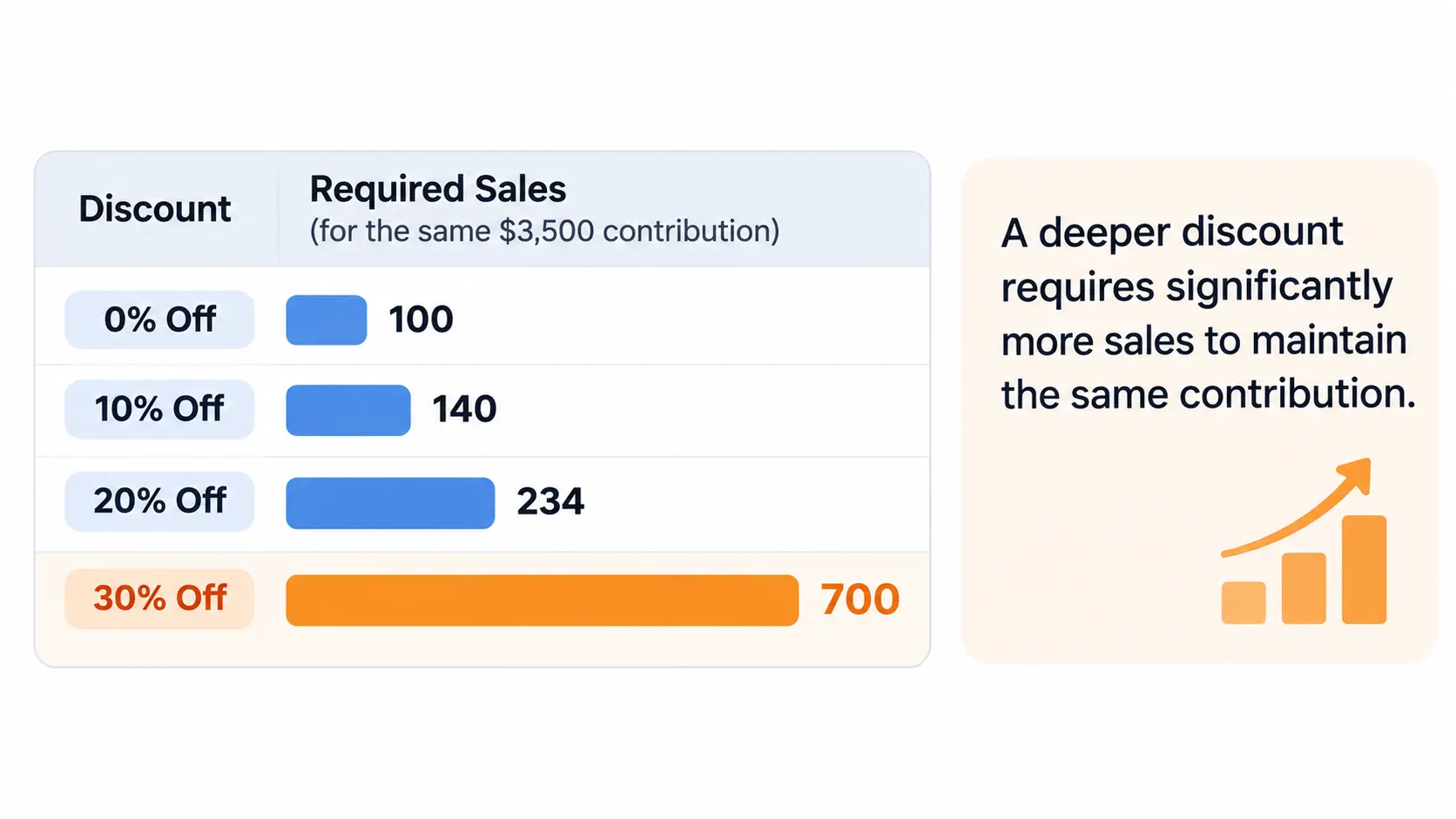
To maintain the same total contribution after discounting, divide your original contribution target by the contribution earned on each discounted sale. The less money you keep per order, the more orders you’ll need.
Imagine your $100 backpack normally generates $35 in contribution per sale. You sell 100 backpacks and generate $3,500 in total contribution.
Now you introduce a discount.
How many backpacks would you need to sell to generate that same $3,500?
| Discount | Contribution per sale | Orders needed to reach $3,500 |
| No discount | $35 | 100 |
| 10% off | $25 | 140 |
| 20% off | $15 | 234 |
| 30% off | $5 | 700 |
| 35% off | $0 | Not possible |
At 20% off, you need more than twice as many orders.
At 30% off, you need seven times as many.
And that’s assuming you don’t increase advertising expenses or incur additional costs to handle the extra orders.
Would your store realistically sell 700 backpacks instead of 100?
Maybe. But you should have a good reason to believe that before offering 30% off.
These are illustrative calculations using constant variable costs. They compare total contribution, not final net profit.
Which Black Friday Discount Strategy Makes Sense for Your Store?
You don’t have to put the same discount on every product.
In fact, that’s often the first thing I’d avoid when a store sells products with very different margins.
Say you run a small electronics store. You sell headphones, charging cables, phone cases, and smartphones.
The phone cases might leave plenty of room for discounts. The smartphones might not.
Why give both 30% off?
Here’s how I’d think about the available options.
Compare Black Friday discount strategies
| Strategy | Example | Best suited for | What to check |
| Percentage discount | 20% off selected products | Products with healthy margins | Contribution after the discount |
| Fixed discount | $10 off orders over $100 | Encouraging larger orders | Profitability of qualifying carts |
| Product-specific discount | 30% off phone cases | Promoting selected products | Individual product margins |
| Bundle discount | Buy two items for $65 | Related products | Combined costs and selling price |
| Free shipping threshold | Free shipping over $75 | Encouraging customers to add items | Seller-paid shipping costs |
The table gives you a starting point. The right choice still depends on what customers buy and what each order costs.
Percentage discounts for selected products
A straightforward percentage discount works well when you know which products can afford it.
You could offer 25% off phone cases, 15% off headphones, and 10% off chargers.
Customers still get a Black Friday deal, but you’re not forcing every product into the same pricing rule.
I’d start with products that have healthy margins and enough demand to justify featuring them.
Then check whether the discounted prices still leave room for fulfillment and customer acquisition costs.
Fixed discounts for larger orders
Suppose your average order is $65.
You could offer $10 off orders over $100.
A customer who planned to buy just one item might add another to qualify.
That sounds useful, but check the numbers.
If the additional product costs you $28 and contributes only $5 before the coupon, you’ve made the order bigger without necessarily making it more profitable.
The minimum order amount should reflect your actual product margins, not just your average cart value.
Bundles when products go well together

Imagine you sell a laptop sleeve for $35 and a wireless mouse for $40.
Together, they normally cost $75.
Instead of offering 25% off both products separately, you could create a bundle for $65.
The customer saves $10 and gets two useful products.
For your store, the question is whether the combined selling price covers both products’ costs and leaves enough contribution.
Bundles work best when the items genuinely belong together.
A customer buying a laptop sleeve might need a mouse. They’re less likely to be excited about an unrelated product added just to make the bundle look bigger.
Free shipping instead of another price cut
Sometimes customers don’t need a deeper product discount. They just don’t want an unexpected shipping charge at checkout.
Suppose someone adds a $45 product to their cart and sees $8 shipping.
You could offer free shipping above $75 rather than reducing every product price.
That might encourage the customer to add another item.
But shipping still costs your business money.
If the extra product has a low margin, covering shipping might wipe out most of the additional contribution.
Check the full cart economics before deciding.
Five Black Friday Discount Mistakes That Can Hurt Your Profit
Picking the discount is only half the job.
The other half is making sure the offer works the way you intended.
Here are five problems that can turn an otherwise reasonable promotion into an expensive mistake.
1. Forgetting how much you’re spending on ads
Let’s say a product leaves you $15 after its Black Friday discount and variable fulfillment costs.
You run Facebook or Google ads and spend $18 to acquire each order.
You’re losing $3 on those orders before fixed expenses.
A campaign dashboard may show plenty of purchases, but that doesn’t tell you whether the sales are profitable.
Look at what it costs to acquire a paying customer, not just how many clicks your ads receive.
If your Black Friday campaign is mostly reaching existing email subscribers, your acquisition costs may be lower.
That’s worth considering when deciding which audience gets which offer.
2. Letting customers combine discounts you didn’t intend to combine
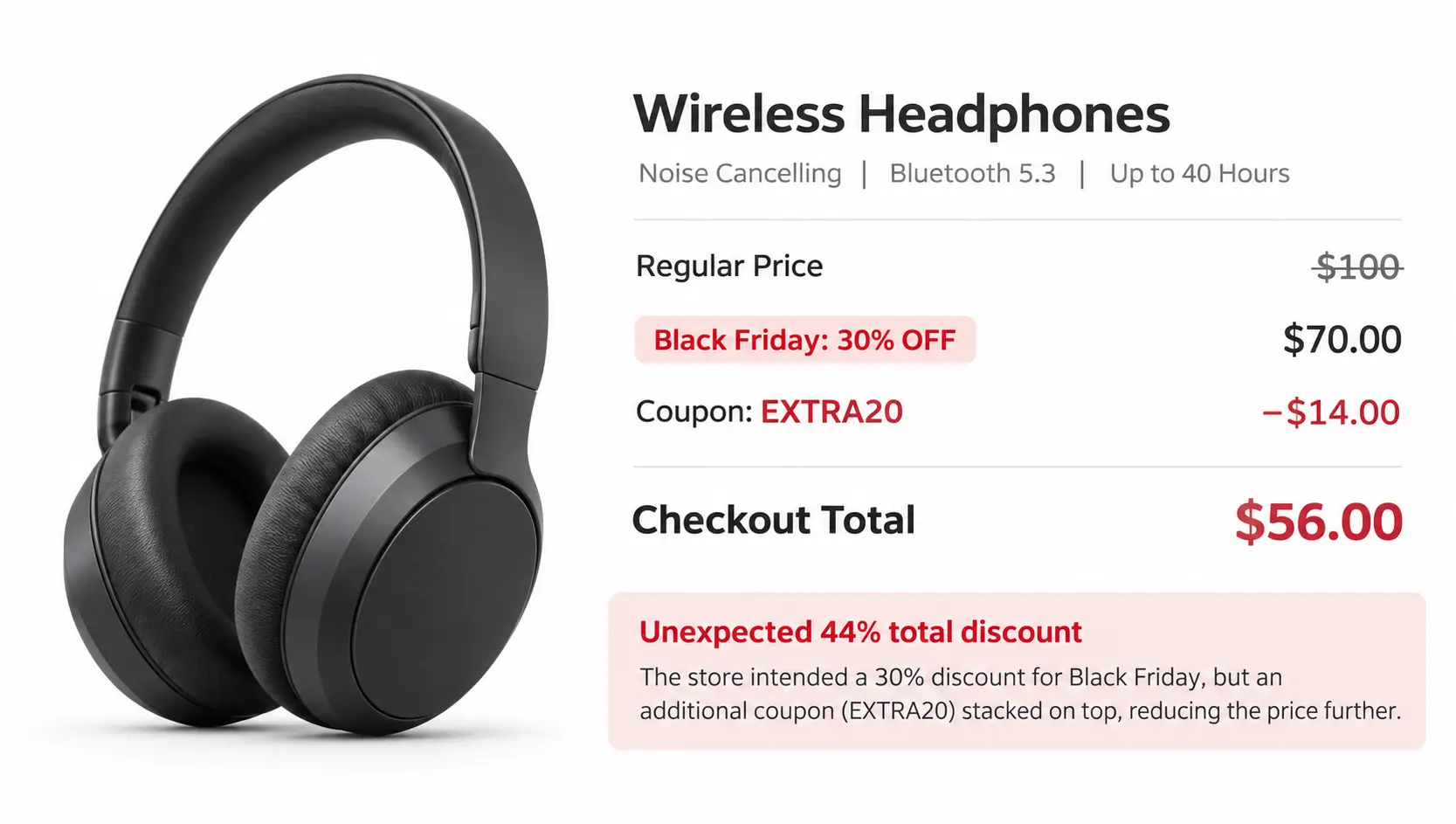
Imagine a customer sees a $100 product with 30% off.
They add it to the cart for $70.
Then they apply a 20% coupon from an older email campaign.
If your store applies that coupon to the discounted price, the customer pays $56.
You intended to offer 30% off. The customer received 44% off the original price.
And if that product costs $60 to fulfill, you’ve lost $4 before paying any other expenses.
Check your coupon settings, existing promotions, and automatic discounts.
Don’t assume an old coupon has stopped working just because you haven’t mentioned it recently.
3. Discounting your most popular products just because they’re popular
Your best-selling product might already sell well without a big price cut.
Imagine you’re selling 100 units a week at full price. Offering 30% off could increase demand, but it also means every existing buyer who would have purchased anyway now pays less.
You need enough additional profitable sales to make up the difference.
A better option might be a smaller discount, a related accessory offer, or early access for returning customers.
Popularity alone isn’t a reason to offer the biggest discount.
4. Forgetting shipping and payment costs
A $50 product that costs $25 to source looks like it has $25 left over.
But what happens when you spend $6 on packaging and shipping, plus payment processing fees?
Suddenly, there’s less room for a discount.
The calculation also changes if the customer qualifies for free shipping or uses a different payment method.
Check your costs using the final amount the customer actually pays.
If some expenses depend on order value, make sure your calculation adjusts them instead of treating every fee as fixed.
5. Ignoring returns
A sale isn’t always finished when the payment goes through.
Some customers will request refunds. Physical products may come back with damaged packaging, and some returned stock might not be suitable for resale at the original price.
There can also be return shipping and handling costs.
If your store normally has a 5% return rate, use that history when estimating how much revenue and contribution you’ll actually keep.
A big Black Friday order count won’t mean much if too many of those orders turn into costly returns.
How to Test Your Black Friday Discounts Before Launch
Test your discounts by placing sample orders with different products, coupons, and cart totals. Check that the final price matches your planned offer, especially when multiple promotions could apply.
Say you’ve chosen 25% off selected products, $10 off orders above $100, and free shipping above $75.
Everything looks fine in your promotion plan.
Now open your store as if you’re a customer.
Add a discounted product to the cart. Add another product that isn’t supposed to be discounted. Try an old coupon code.
Then change the cart total to see whether your spending thresholds behave correctly.
A few things I’d check:
- Does each product show the correct regular and discounted price?
- Can customers apply an old coupon on top of the Black Friday offer?
- Does the minimum order amount work correctly?
- Does free shipping appear only when the order qualifies?
- Are the tax, shipping, and final payment amounts correct?
- Does the order confirmation show the actual amount paid?
One wrong rule can affect every order during the campaign.
And when customers are already buying, changing prices or canceling mistaken orders becomes much more difficult.
If you’re using EasyCommerce on WordPress, review your coupon and promotion settings against these scenarios, including any active offers from previous campaigns.
We’ve covered the full checkout-testing process separately in How to Test Your Store’s Checkout Before Black Friday.
You don’t need to test every possible shopping combination. Start with the ones most likely to create pricing mistakes, then complete at least one test purchase using an appropriate payment test environment.
Before You Publish That 30% OFF Banner
Go back to the products you plan to promote.
Check what they cost, how much money you’ll have left at the discounted price, and whether you can afford the advertising and fulfillment expenses.
Then try the numbers in the calculator.
You might find that 20% off is enough. You might discover that a bundle makes more sense, or that some products shouldn’t be discounted at all.
Either way, you’ll be making the decision with your actual costs in front of you.
Because getting more Black Friday orders is good. Having enough money left from those orders to run your business is what makes the campaign worthwhile.
Frequently Asked Questions
Yes, 20% off can be enough, depending on your products, margins, and competing offers. A larger discount isn't automatically better. If competitors offer 30% off similar products, you might need another reason for customers to choose your store. Faster delivery, a useful bundle, or a product customers can't easily find elsewhere can make a smaller discount attractive.
Subtract the discount from the regular selling price. Then subtract the variable costs of fulfilling that sale. For example, a $100 product with 20% off sells for $80. If its variable costs are $60, you have $20 left. That's your contribution before fixed expenses, not necessarily your final net profit.
Your break-even discount is the percentage reduction that brings your selling price down to your variable cost per sale. If a product sells for $100 and costs $65 per sale, a 35% discount brings its contribution to zero. But you still have business expenses to cover. A smaller discount is needed to keep a positive contribution margin.
No. Start by comparing the margins of different products. A product with a healthy margin may support 30% off. Another product might only support 10%. You can also use selected product offers, bundles, or order-value discounts rather than reducing every price.