Ecommerce has always required shoppers to do the work: search for products, compare options, make decisions, and complete checkout.
Agentic commerce changes that model by allowing AI agents to handle much of this process on a customer’s behalf. But the term is often used too broadly, with simple shopping chatbots being labeled as “agentic”
The distinction is becoming more important as the technology moves from concept to implementation. New standards and web capabilities are enabling AI agents to discover products, understand store information, take action, and complete transactions.
According to Koddi’s 2026 research, 72% of consumers in the US, UK, and Germany already want AI as a shopping co-pilot, not full autopilot. The demand is real, and it is growing faster than most store owners expected.
This guide explains what agentic commerce actually means, how the process works from discovery to purchase, the protocols enabling it, and what WordPress store owners need to know.
What Is an AI Agent?
Before getting into agentic commerce, it helps to understand what an AI agent actually is, because the word “agent” is doing a lot of work in this conversation.
An AI agent is software that can understand a goal, break it down into steps, and take actions to complete it, without someone directing each step manually. That last part is what separates an agent from a regular AI tool.
A regular AI tool responds to a single prompt. You ask a question, you get an answer. An AI agent takes an objective and figures out how to get there. It can search for information, evaluate options, make decisions based on criteria you set, interact with external systems, and execute a sequence of actions.
Think of it this way:
| Regular AI tool | AI agent |
|---|---|
| You ask, it answers | You set a goal, it works toward it |
| One step at a time | Plans and executes multiple steps |
| Needs instructions for each action | Decides which actions to take |
| Stops after responding | Keeps going until the goal is met |
| Example: “What’s the cheapest laptop under $800?” | Example: “Find me a laptop under $800 for video editing and buy it” |
In ecommerce, that distinction matters because of what each side of the transaction needs. A shopper needs an agent that can search, compare, and buy. A store owner needs an agent that can answer questions, recommend products, and close sales. The same AI agent can do both, simultaneously, in the same conversation.
That is the foundation agentic commerce is built on.
What Is Agentic Commerce, Exactly?
At its simplest, agentic commerce means an AI agent completing commerce tasks on behalf of both sides of a transaction: the shopper and the store owner.
For the shopper, the agent finds products, compares options, answers questions, and completes the purchase. For the store owner, the same agent is a 24/7 sales assistant, product recommender, and support representative, working without the owner being present.
One agent. Two sides served. That is what makes it different from a chatbot that only answers questions.
A Simple Example
Imagine a shopper says:
“Find me trail running shoes under $150 that can arrive by Friday.”
Instead of browsing multiple stores themselves, the shopper’s AI agent could:
- Search products across merchants
- Compare prices, features, and delivery options
- Check availability
- Select the best match based on the shopper’s preferences
- Complete the purchase
The shopper sets the goal and constraints. The AI handles the work.
Now look at the same transaction from the store owner’s side. The owner did not answer the shopper’s questions, did not recommend a product, did not check inventory, and did not process the order. The agent did all of that on their behalf while they were asleep or running a different part of the business
Agentic Commerce vs. a Shopping Chatbot
This is where agentic commerce differs from a typical ecommerce chatbot.
| Traditional Shopping Chatbot | Agentic Commerce |
| Answers product questions | Understands the shopper’s goal |
| Recommends products | Searches and compares options |
| Helps with product discovery | Makes decisions based on set parameters |
| Hands the shopper to checkout | Can complete the transaction |
| Primarily provides information | Takes action on the shopper’s behalf |
| Only helps the shopper | Works for the shopper and the store owner simultaneously |
The difference is important because the AI isn’t simply helping someone shop. It can become the interface through which the purchase happens.
Agentic AI vs. Agentic Commerce
The simplest distinction is this: agentic AI is the broader technology, while agentic commerce is its ecommerce application.
| Aspect | Agentic AI | Agentic Commerce |
| What it is | Autonomous AI | AI applied to commerce |
| Main goal | Complete tasks | Complete commerce tasks |
| Scope | Multiple industries | Ecommerce and retail |
| Core focus | Reasoning + action | Shopping + transactions |
| Common tasks | Research, coding, workflows | Product search, comparison, checkout |
| Information used | APIs, databases, business tools | Catalogs, prices, inventory, orders |
| Users | Businesses, developers, consumers | Shoppers and merchants |
| Main benefit | Automation and productivity | Easier, faster shopping |
| Example | AI agent managing a workflow | AI agent finding and buying a product |
This distinction is important because not every AI-powered shopping tool is agentic commerce. A chatbot that recommends products is using AI. An agent that can understand a goal and take actions toward completing the purchase is much closer to the agentic commerce model.
How Agentic Commerce Actually Works
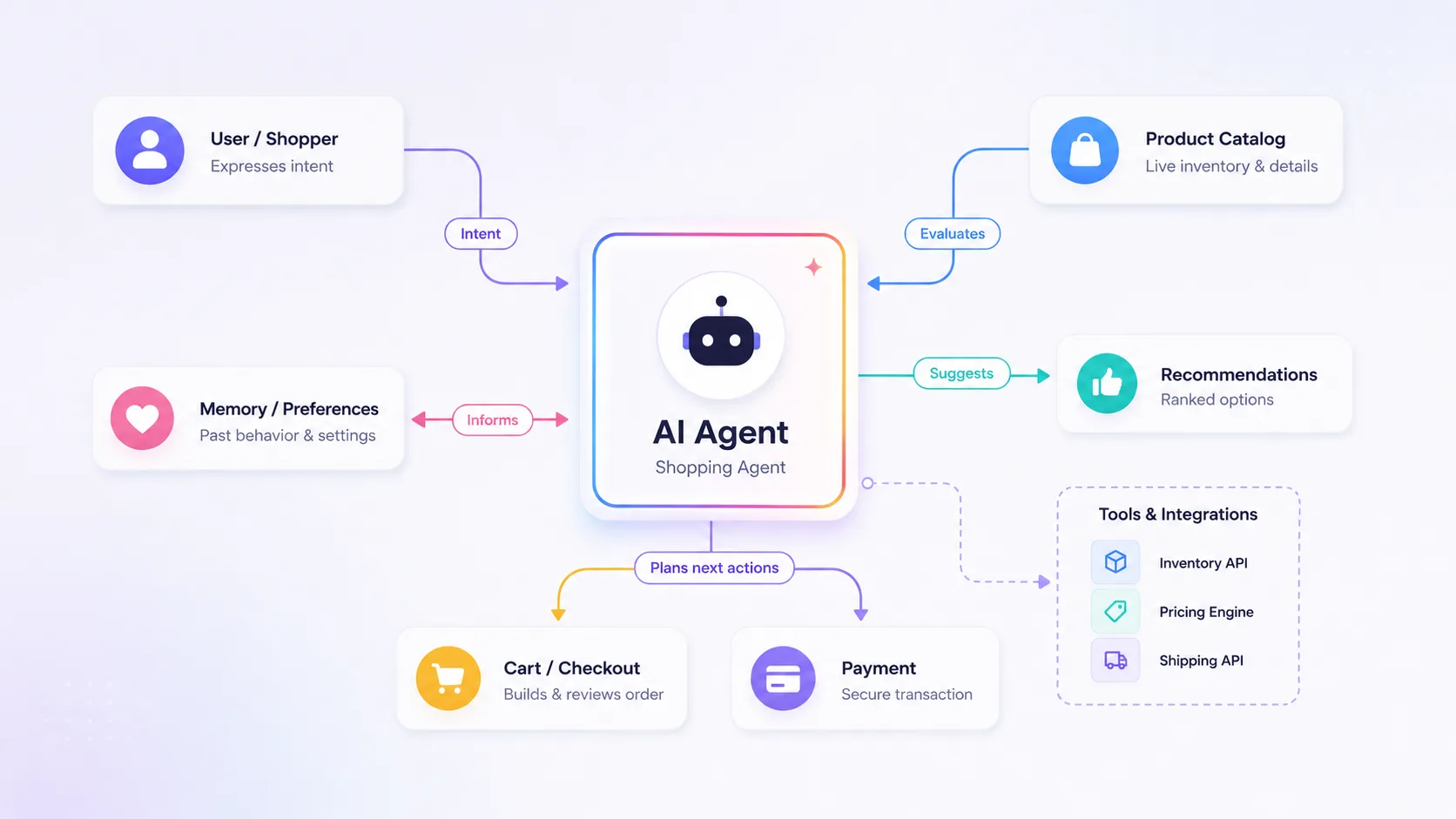
Strip away the marketing language and an agentic transaction moves through four fairly predictable stages. Understanding them matters more than memorizing any single protocol name, because it’s the sequence that determines what your store needs to expose.
Discovery: How the Agent Finds Products
An AI shopping agent may not browse your storefront the way a human does. Depending on the platform, it can rely heavily on structured product data, feeds, APIs, or merchant-provided capabilities.
If that data is incomplete or hard to parse, the agent moves to a competitor who’s easier to read. There’s no second chance here the way there might be with a human who gets frustrated and tries again.
Comparison and Decision-Making
Once the agent has a shortlist, it weighs price, delivery window, and stated preferences against what each merchant can actually deliver. This step happens in seconds and never touches your storefront’s visual design.
Multimodal AI can understand images, and shopping systems can incorporate visual data. What is fair to say is that machine-readable information becomes much more important when purchasing decisions occur through agents.
Checkout and Payment
The agent completes the transaction using the payment method available in the merchant’s system. In some implementations, that means a delegated payment credential from the shopper. In others, such as EasyCommerce’s AI Shopping Agent, the agent creates the order and generates a secure payment link the shopper uses to complete the purchase.
The agent completes the transaction using a delegated payment credential, typically single-use and capped at a specific amount, so the shopper stays in control of spend even though they never touched a checkout form.
Merchants remain the seller of record throughout, meaning fulfillment logic, financial liability, and the customer relationship all stay with the store, not the AI platform. That’s a deliberate design choice across the major protocols, and it’s good news for smaller merchants who’d otherwise worry about losing the customer relationship to a middleman.
Post-Purchase Handling
The agent can track the order, surface delivery notifications, and in some implementations initiate a return or exchange without the shopper opening an app. This is where agentic commerce quietly overlaps with customer service, and it’s the stage most current WordPress plugins haven’t touched yet.
Where Can You Use Agentic Commerce Today?
Agentic commerce is still developing, but store owners don’t have to wait for fully autonomous shopping to become mainstream. Many of its building blocks are already useful today, particularly for product discovery, shopping assistance, product recommendations, and purchase support.
The important distinction is that agentic commerce works for both sides. For the shopper, it is a better way to find and buy products. For the store owner, it is a sales channel that runs without them. Each use case below serves both.

The important distinction is that agentic commerce isn’t simply about adding an AI chatbot to your store. The real opportunity comes when AI can understand what a shopper wants, access your store’s data, and help move that shopper toward the right purchase.
Here are some of the most practical applications today.
1. Personalized Product Discovery
Instead of asking shoppers to browse categories, apply filters, and compare dozens of products, an AI agent can interpret what they’re actually looking for.
A shopper might ask:
“I need a lightweight laptop under $1,000 for video editing.”
An agent can turn that request into specific requirements, search the available catalog, and surface products that match the shopper’s budget and needs.
This changes product discovery from searching through a catalog to describing an outcome.
For the store owner, this means their catalog gets surfaced to the right shopper at the right moment, without relying on the shopper finding the right category page or filter combination.
2. AI-Powered Shopping Assistance
AI can act as a shopping assistant that is available around the clock.
Instead of answering only generic questions, it can use information from the store to help shoppers understand product specifications, compatibility, availability, shipping options, and return policies.
For example, a customer buying a camera could ask which lens is compatible with a particular model. A shopper buying a software license could ask which plan includes a specific feature.
The goal is not simply to automate customer support. It is to help shoppers get the information they need while they are making a buying decision.
For the store owner, this is the equivalent of having a knowledgeable sales associate available on every page, at every hour, handling questions that would otherwise go unanswered or end in a bounce.
3. Product Recommendations and Bundling
Agentic systems can also make recommendations based on a shopper’s stated needs rather than relying only on predefined “related products.”
For example, someone purchasing a home office desk might also need a monitor stand, desk lamp, and cable management kit. An AI agent can understand the context of the purchase and suggest products that make sense together.
For merchants, this creates an opportunity to make product recommendations more contextual and personalized instead of showing the same recommendations to every shopper.
That is upselling and cross-selling happening automatically, driven by what the shopper actually needs rather than a static “frequently bought together” list.
4. Comparing Products and Explaining Trade-Offs
Shoppers often struggle when several products appear to offer similar features.
An AI agent can compare products against the shopper’s priorities and explain the differences in plain language.
For example, instead of simply showing five laptops side by side, it could explain which one is the best fit for someone who prioritizes battery life, which offers the most performance within a budget, and which is better suited for portability.
This makes AI useful not only for finding products, but also for helping shoppers understand why one option may be better for them.
For the store owner, this is the sales pitch they would give in person, delivered consistently to every visitor, without them needing to be there.
5. Conversational Purchase Support
The conversation doesn’t have to stop once a shopper has found a product.
AI can help with questions that typically create hesitation before checkout, such as:
- Is this product currently available?
- When can it be delivered?
- Does it work with my existing setup?
- Which payment options are available?
- What happens if I need to return it?
Depending on the store’s technology and integrations, AI can eventually go beyond answering these questions and assist with actions such as adding products to a cart or initiating a purchase.
This is where conversational shopping begins to move from answering questions to taking action.
For the store owner, every one of those questions answered is a sale that would have been lost to hesitation. The agent is closing objections in real time.
6. Post-Purchase Assistance
Agentic commerce can also extend beyond the purchase itself.
An AI system could help customers check order information, understand delivery updates, find return instructions, or start a support request without requiring them to navigate multiple pages.
For merchants, this creates another opportunity: the same AI layer that helps a shopper choose a product can potentially continue supporting that customer after the order is placed.
That is customer service running without a support ticket queue, without a help desk login, and without the store owner monitoring a dashboard.
EasyCommerce’s AI Shopping Agent already handles use cases 1 through 5 out of the box: product discovery, shopping assistance, recommendations, comparisons, and conversational checkout. The Store Copilot covers the merchant’s admin side. See how it works on a live store.
Curious about how AI is changing the way online stores work? We’ve covered the topic in more detail in our guide on AI in Ecommerce.
The Protocols Behind Agentic Commerce

Agentic commerce doesn’t rely on a single protocol. Several standards are emerging to help AI agents discover products, interact with merchants, access information, and complete transactions.
Three names you’ll encounter frequently are UCP, ACP, and MCP. They aren’t direct competitors, and they don’t map neatly to three separate stages of the buying journey.
1. UCP: Connecting AI Agents With Commerce Systems
Universal Commerce Protocol (UCP) is an open-source commerce standard developed by Google with Shopify and other industry partners.
Its goal is to provide a common way for AI agents and consumer-facing AI experiences to interact with businesses across the commerce journey from product discovery through purchase. Google says UCP can work with existing APIs, Agent2Agent (A2A), and MCP, while also supporting different payment providers.
UCP is designed to help connect experiences such as Gemini and AI Mode in Google Search with merchant backends.
2. ACP: Enabling Commerce Inside AI Experiences
Agentic Commerce Protocol (ACP) was co-developed by OpenAI and Stripe with merchant partners.
It originally powered Instant Checkout in ChatGPT, allowing users to purchase from participating merchants without leaving the chat. The merchant remains responsible for payment processing, fulfillment, returns, and customer support.
ACP has since expanded beyond checkout. In March 2026, OpenAI announced that ACP would also support product discovery, allowing merchants to provide product feeds and promotions to ChatGPT.
3. MCP: Giving AI Models Access to Data and Tools
Model Context Protocol (MCP) is different from UCP and ACP.
Created by Anthropic, MCP is a general-purpose open protocol that standardizes how AI applications connect to external data sources and tools.
For ecommerce, an MCP connection could potentially give an AI agent access to relevant merchant systems or tools. But MCP itself isn’t a commerce or checkout protocol. Think of it as a general connection layer for AI applications, rather than a standard specifically designed to complete purchases.
MCP is worth a closer look for WordPress specifically, since it’s the one plugin developers are most likely to touch directly. EasyCommerce, for example, ships an MCP server that lets tools like Claude Desktop, Claude Code, Cursor, and so on connect straight to a store’s catalog, which is a concrete example of what “protocol support” looks like in practice rather than as a roadmap item.
What This Means for WordPress Store Owners?
Agentic commerce isn’t limited to large retailers like Amazon. WordPress introduced the Abilities API in version 6.9 (December 2025), a platform-level capability that creates a central registry of site functions, making them discoverable and accessible to AI agents.
That matters for smaller stores because preparing for AI-driven commerce doesn’t necessarily require an enterprise contract or a team of developers building custom integrations from scratch. Instead, WordPress is laying the groundwork for AI agents to interact with the same software that powers millions of online stores.
EasyCommerce builds directly on top of that foundation rather than treating agentic AI as a future feature.
The plugin’s AI Shopping Agent works both sides of the transaction. For the shopper, it searches the catalog, shows matching products with prices, checks stock, and creates the order. For the store owner, it is a sales team that operates around the clock, answering questions, recommending products, and closing sales without the owner being present.
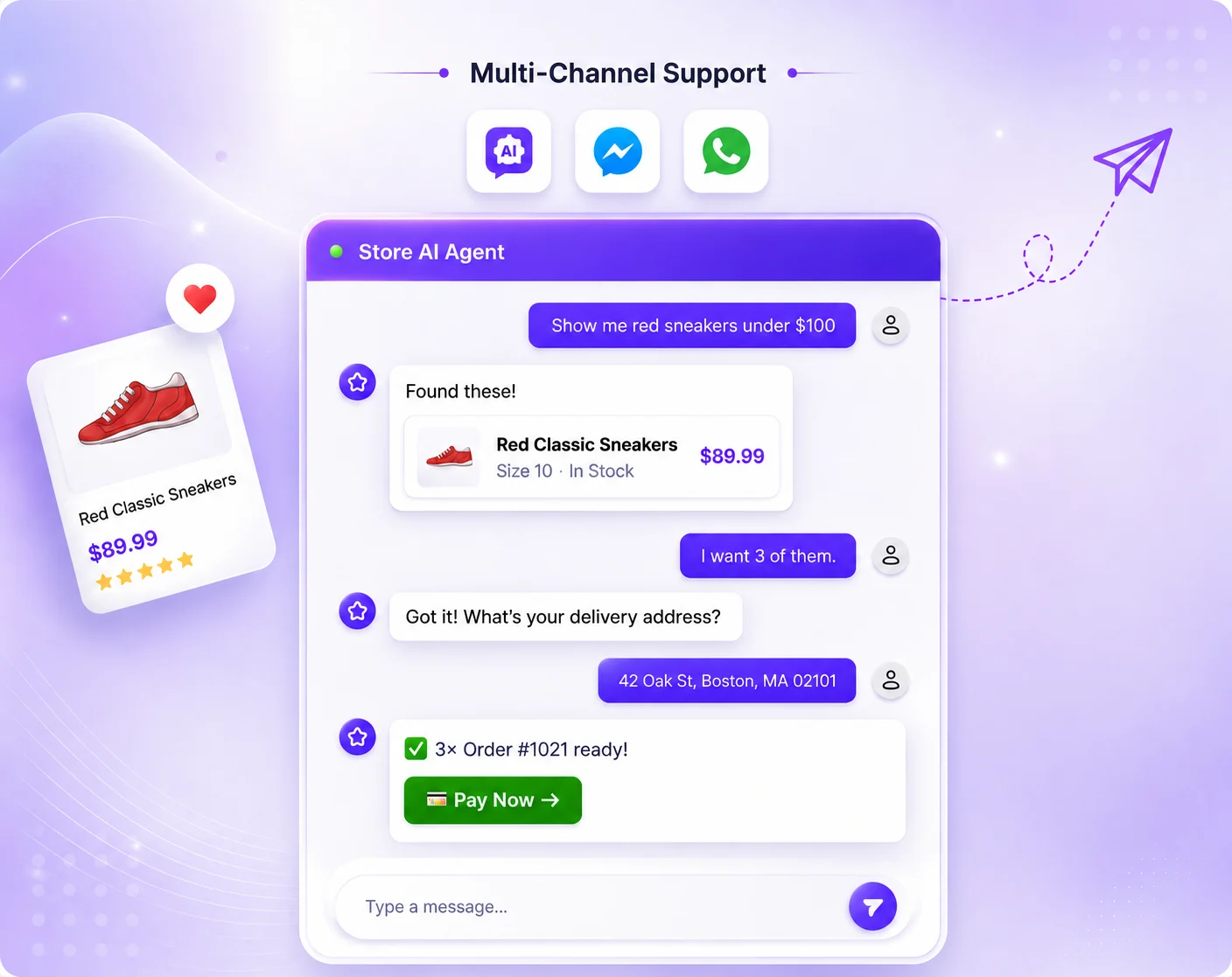
- The plugin’s AI Shopping Agent searches a store’s catalog, checks stock, creates the order, and generates a payment link, completing a full purchase through conversation rather than a traditional add-to-cart flow.
- A Multi-Channel Agent extends that same agent to Facebook Messenger, with WhatsApp support planned. None of this requires custom development work from the store owner. It’s a matter of activating what’s already there.
Final Words
Agentic commerce is still small in absolute terms, but the direction is unmistakable, and the infrastructure supporting it moved from theoretical to shipped faster than most store owners expected. WordPress store owners have an advantage here that’s easy to overlook: the platform-level groundwork already exists, and plugins like EasyCommerce are building working agentic features on top of it rather than waiting for a future release cycle.
The practical move right now isn’t picking a protocol to bet on. It’s making sure your product data is structured, your catalog responds fast under API load, and your plugin actually supports the AI tools your customers, human or otherwise, are starting to use. Explore EasyCommerce’s AI features to see what agent-ready looks like on a live WordPress store today.
Frequently Asked Questions
No. A chatbot answers questions. Agentic commerce can search, decide, and complete purchases for the shopper.
No. You need structured product data and ecommerce tools that support AI agents, such as MCP or shopping agents.
EasyCommerce includes an AI Shopping Agent, Store Copilot, Multi-Channel Agent, and MCP server for connecting AI tools to your store.
No. AI agents are an additional shopping channel, not a replacement for traditional search and browsing.